Die Gegenwart des Historischen in Christian Petzolds Transit

„Ein Transit – das ist die Erlaubnis, ein Land zu durchfahren, wenn es feststeht, daß man nicht bleiben will.“1

„»Ich sage Ihnen zum dritten Mal: Man läßt Sie hier nur eine Zeitlang in Ruhe bleiben, wenn Sie nachweisen, daß Sie abfahren wollen. Verstehen Sie das nicht?« Ich sagte: »Nein.«“2

Christian Petzolds Film Transit (2018) ist auf zweifache Weise das Ergebnis eines Transfers: als Verfilmung des gleichnamigen Exilromans von Anna Seghers (1944/48) und als Übertragung historischer Ereignisse in das Setting der Gegenwart. Der Besuch der Filmvorführung und eine knappe Notiz, die Harun Farockis (1944–2014) frühes Interesse für den Roman dokumentiert, lassen danach fragen, auf welche Weise die Gegenwart des Historischen in Transit behandelt wird.3
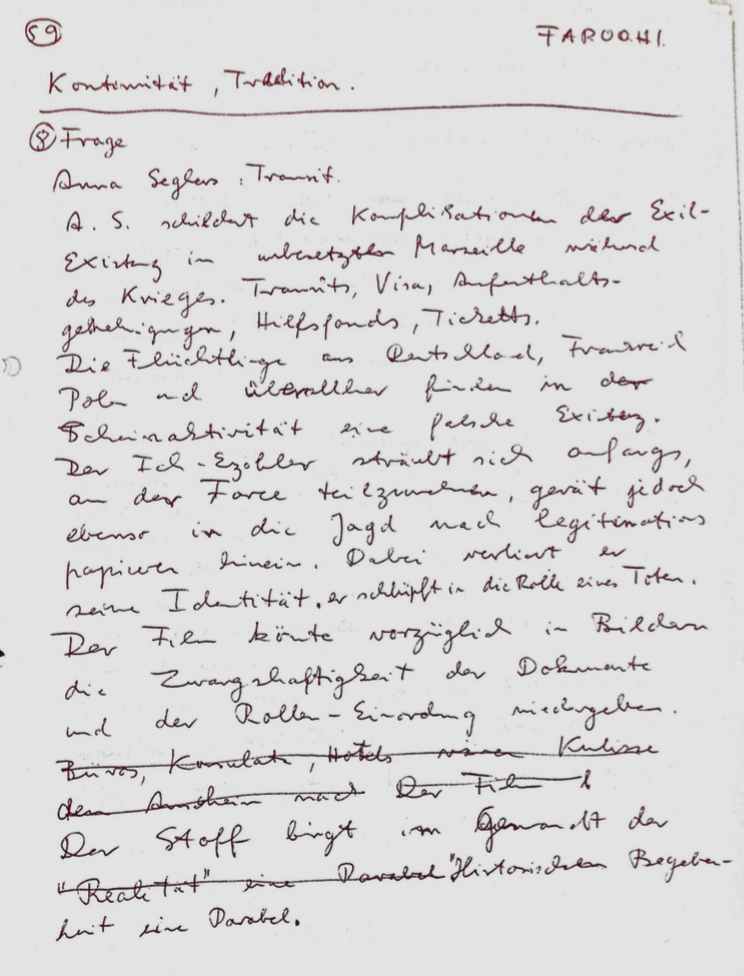
Abb. 1: Harun Farocki, Dokument über die Zulassungsprüfung an der Deutschen Film- und Fernsehakademie Berlin (DFFB), Mai 1966
Quelle: Deutsche Kinemathek, Schriftgutarchiv: Signatur: N 7815-dffb

Farocki, den Petzold aus der gemeinsamen Studienzeit an der Deutschen Film- und Fernsehakademie Berlin (DFFB) kannte, blieb über viele Filmprojekte hinweg ein dauerhafter Gesprächspartner. Wie die Widmung im Vorspann von Transit nahelegt, gingen wohl auch für dieses Projekt wichtige Impulse von Farocki aus. Als eines seiner Lieblingsbücher hat Farocki Petzold bereits in den siebziger Jahren mit dem Buch bekanntgemacht: Die Schriftstellerin Seghers verarbeitet in diesem Roman ihre eigenen Erfahrungen, die sie während ihrer Emigration Anfang der vierziger Jahre gesammelt hatte.4 Auf der Flucht vor den nunmehr auch in Frankreich einfallenden Faschisten steuerte sie zusammen mit ihren Kindern den Überseehafen in Marseille an, um von dort aus weiter nach Mexiko zu fliehen. Eine im Rahmen seiner Aufnahmeprüfung an der DFFB angefertigte handschriftliche Notiz verrät, dass Farocki bereits 1966 über die Bearbeitung des Romans nachdachte (Abb. 1).5 Seine knappen Formulierungen sind bemerkenswert aktuell: In „Scheinaktivität[en]“ finden die Flüchtlinge „eine falsche Existenz“.6 Diese sei charakterisiert durch die unaufhörliche „Jagd nach Legitimationspapieren“, eine „Farce“ deren zersetzende „Zwanghaftigkeit“ sich insbesondere in der existentiell werdenden Abhängigkeit von „Transits, Visa, Aufenthaltsgenehmigungen, Hilfsfonds, Tickets“ zeige. Farocki notiert, dass der Stoff geeignet ist „vorzüglich in [den] Bildern“ eines Films wiedergegeben zu werden. Die buchhalterische „Zwanghaftigkeit der Dokumente“ triumphiere über die Identität der Lebenden, die schließlich sogar abhanden zu kommen droht und ausgerechnet in derjenigen eines Toten neue Legitimation erfährt. „Der Stoff birgt im Gewand der ‚Realität‘ […] ‚Historischen Begebenheit‘ eine Parabel“, notiert Farocki abschließend. Das gestrichene Wort „Realität“ deutet dabei auf ein Verständnis des Historischen, das abseits von einem mimetisch gedachten Konzept von Realismus zu suchen ist.

Petzolds Transit ist nach Barbara (2012) und Phoenix (2014) der dritte Teil einer Trilogie historischer Stoffe. Den Entstehungsprozess des Projektes hat Farocki noch größtenteils begleiten können. „So könne man historische Themen behandeln“, soll er über den Film gesagt haben, wie sich Petzold erinnert.7 Das langanhaltende gemeinsame Gespräch über das bereits 2014 bewilligte Projekt zur Verfilmung des Buches von Seghers konnte jedoch nicht mehr fortgesetzt werden: Nach Farockis Tod legte Petzold die Arbeit vorerst nieder, um sich mit zwei Polizeiruf-Produktionen wieder der „Arbeit im Gegenwärtigen“ zu verschreiben.8

Gegenwart und Vergangenheit sind die beiden wesentlichen Zentripetalkräfte, die den Film Transit bestimmen. Obwohl der Film optisch der Gegenwart verhaftet bleibt, erwecken einzelne Worte und Dinge den Anschein des Historischen. Mehrfach durchkreuzen Schienengleise die Leinwand, die im Auf und Ab der Gleis- und Weichenführung die Partitur des Films leitmotivisch einfangen (Abb. 2). Auf der Ebene der Handlung entspricht die ununterbrochene Unruhe der Protagonisten dem beständigen Zeitendrift. Andauernd in Furcht versetzt, entweder entdeckt oder verraten zu werden, ist kaum ein Ort in der Lage, Geborgenheit zu vermitteln. Denn neben die unumgänglichen „Nicht-Orten“ (Marc Augé), die bürokratischen Wartezonen, reihen sich vielfach jene Orte und Räume, die als Transitzonen nur vorübergehend Aufenthalt erlauben: Bahnhof, Hafen, Hotelzimmer, Straßengasse, Taxi und schließlich ein Bistro. Dieser Ort und mehr noch der Wirt (Matthias Brandt), der zugleich als Erzählstimme durch den Film begleitet, bilden den einzigen Fixpunkt, in dessen Gravitationsfeld die Figuren ihre Bahnen ziehen.
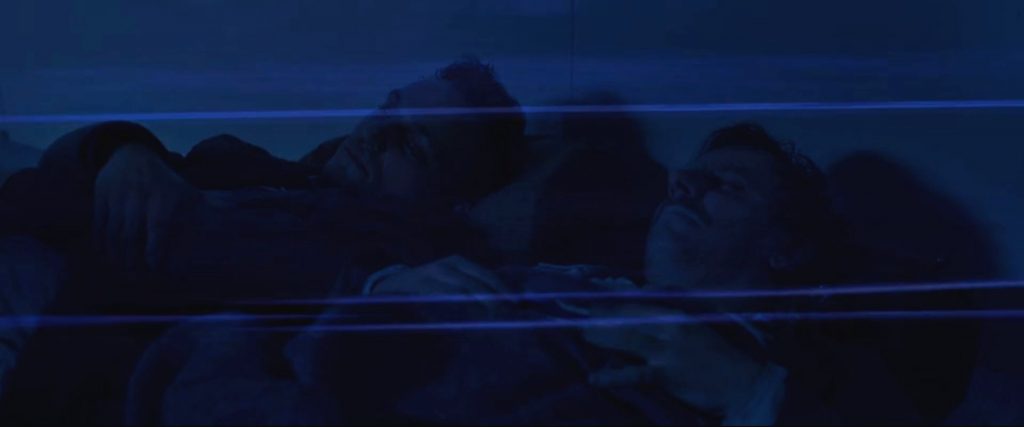
Abb. 2: Georg und Heinz auf der Flucht nach Marseille, Christian Petzold, Transit, 2018
Quelle: DVD, good!movies 2018

Georg (Franz Rogowski) gerät als eine Art Mittelsmann eher beiläufig in die Handlung hinein. In einer Pariser Bar trifft er zunächst auf Paul (Sebastian Hülk), einen alten Bekannten, der ihn um einen Gefallen bittet. Zwei Briefe sollen dem Schriftsteller Franz Weidel überstellt werden, der in einem benachbarten Hotel wohnt. Als Gegenleistung winken etwas Geld und die Aussicht die Stadt zu verlassen – ein Platz im Auto sei noch frei. Im Hotel findet Georg nur noch das verlassene Zimmer vor. Das blutverschmierte Badezimmer deutet auf den Suizid des Schriftstellers. Paradoxerweise imaginieren dessen Hinterlassenschaften eine Form der Anwesenheit, die gegenüber jener raumgreifenden Abwesenheit opponiert, die der Tod für gewöhnlich hinterlässt. Und selbst noch in den Erzählungen der Hotelangestellten (Emilie de Preissac), die den Gast von früheren Besuchen zusammen mit seiner Frau her kannte, nimmt die Person des Schriftstellers förmlich Gestalt an. Das zurückgelassene Typoskript des letzten Buchprojektes zeichnet darüber hinaus das Bild eines melancholisch gewordenen Romantikers, dessen Zukunft plötzlich aussichtslos erschien. Georg ergreift die Chance, die sich durch die Leerstelle des Abwesenden ergibt. Er nimmt das Typoskript, die Briefe, den Pass und die Reisepapiere an sich und wird sich letztlich sogar – wenn auch zögerlich – die Identität des Schriftstellers aneignen. Für einen kurzen Moment eröffnet sich eine alternative Perspektive, die nur im falschen Leben ein (Über-)Leben verspricht. Der rettende Transit gerät erst dann in greifbare Nähe, wenn sich auch die Identitäten selbst im Übergang befinden. Aber der Fluchtplan misslingt. Paul wird von einer Polizeieinheit aufgegriffen und Georg kann gerade noch rechtzeitig entkommen. Die Situation verschärft sich, da die Ordnungskräfte das Viertel systematisch zu durchkämmen beginnen und die Stadt abgeriegelt zu werden droht. Doch bevor Georg überhaupt die Gelegenheit dazu bekommt sich einen Ausweg zu ersinnen, erhält er schon den nächsten Auftrag. Er soll seinen verwundeten Freund Heinz (Ronald Kukulies) in Sicherheit bringen. Auf einem Güterzug in einem Baucontainer versteckt, versuchen beide nach Marseille zu flüchten, doch der Freund erliegt seinen schweren Verletzungen. In Marseille angekommen kann Georg den herannahenden Ordnungskräften erneut nur knapp entwischen.
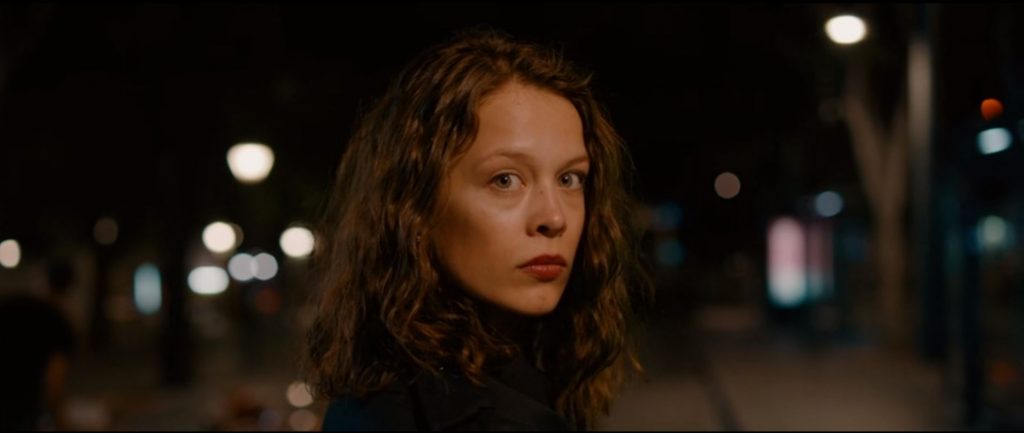
Abb. 3: Marie hört ihren Namen und wendet sich um, Christian Petzold, Transit, 2018
Quelle: DVD, good!movies 2018

Marie (Paula Beer) ist ein rastloses umherwandelndes Phantom (Abb. 3): Die meiste Zeit des Films ist vornehmlich das hektische Klackern ihrer Schuhabsätze zu vernehmen. Auf der Suche nach ihrem Mann, dem Schriftsteller, kreuzen sich ihre Wege und Blicke immer wieder mit denjenigen Georgs. Dann eine Berührung, – die Hand auf seiner Schulter – eine Kontaktaufnahme ganz „aus Versehen“ (Abb. 4). Georg, der inzwischen die Identität des Schriftstellers angenommen hat, scheint diesem (wenn auch nur rückseitig) zu ähneln. Doch sobald er sich umwendet, reißt ihre nur kurzweilig andauernde Kontaktaufnahme ab. Wie schon im antiken Mythos führt seine Geste der Hinwendung (Orpheus, der hinter sich blickt) zu Verlust und Abwendung.9

Georg, dessen Name an den ebenfalls um 1940 nach Südfrankreich geflohenen Schriftsteller Georg K. Glaser angelehnt sein könnte, scheint ohne jede Vergangenheit.10 Eine unter den gegebenen Umständen mögliche Identität findet er allein in der Gegenwart. Marie dagegen fehlt im gleichen Maße der Zugang zur Gegenwart wie ihre Erscheinung selbst flüchtig und ungreifbar bleibt. Dem Nachhall eines allmählich ausklingenden Echos vergleichbar, scheint der initiale Impuls ihrer Identität allein aus der Vergangenheit begründet. Diese Form permanenter Zeitversetzung führt jedoch dazu, dass Georg und Marie, wie im Falle einer entgegengesetzten Polarität, kaum länger als für einen kurzen Augenblick zusammenbleiben können.
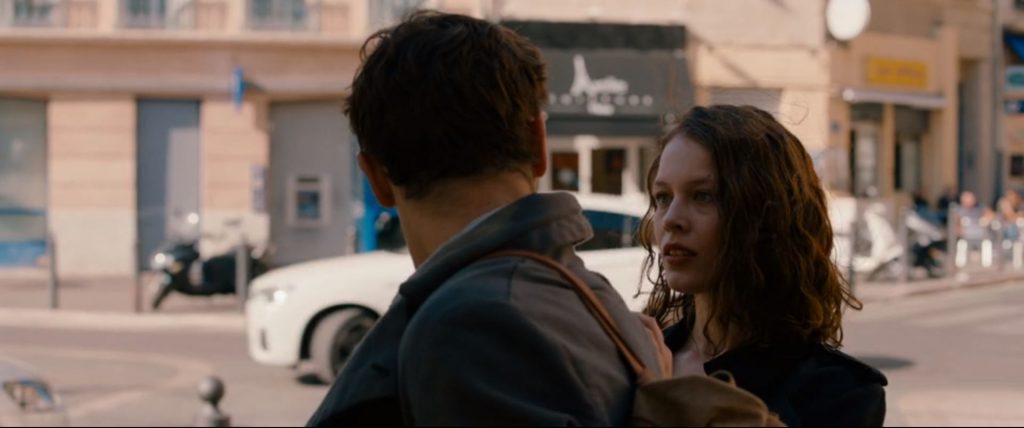
Abb. 4: Marie glaubt ihren Mann wiedererkannt zu haben, Christian Petzold, Transit, 2018
Quelle: DVD, good!movies 2018

Driss (Lilien Batman), der kleine Sohn des auf der Flucht verstorbenen Freundes, entwickelt dagegen eine ganz und gar gegenwärtige Präsenz. Im Spiel mit dem Jungen gewinnt Georg sogar eine Lebendigkeit zurück, die Erinnerungen an seine frühere Identität preisgibt. Für einen Moment eröffnet sich ihm eine alternative Zukunftsperspektive. Erneut könnte er eine Lücke füllen, die durch den verstorbenen Freund und Vater des Jungen gerissen wurde und es bräuchte dazu keinerlei „Schein-Identität“ oder Verstellung mehr: Wäre er bereit zu bleiben, dann würde der Junge ihn akzeptieren, ganz ohne Dokumente und mit welchem Namen auch immer. Die Szene, in der Georg das defekte Radio des Jungen repariert, spiegelt diese Konstellation besonders eindringlich wieder (Abb. 5). Hatte sich Georg dem Jungen zunächst nur aus Neugier und wahrscheinlich auch ein wenig aus Mitleid zugewandt, entsteht zwischen ihnen mehr und mehr eine Verbindung, die sich auf Zuneigung und Verantwortung gründet. Die Reparatur des Radios steht sinnbildlich für die Wiederherstellung eines unterbrochenen Kontaktes, der Vergangenheit, Gegenwart und Zukunft wieder miteinander verknüpft. Nicht nur, dass die Handarbeit Georg auf seine Ausbildung als Radio- und Fernsehtechniker zurückführt, aus dem Rauschen des Radios erklingt auch eine Melodie, in der Georg ein Lied (das „Abendlied“ von Hans-Dieter Hüsch) seiner Kindheit wiedererkennt. Das Tableau der Figuren ließe sich noch weiter entfalten, die Mutter des kleinen Jungen (Maryam Zaree) und der Arzt (Godehard Giese) … Ihnen allen gemein ist, dass sich ihre Wege mehrfach kreuzen und sich stetig neue Konstellationen zwischen ihnen eröffnen.

Abb. 5: Reparatur und Kontaktaufnahme zwischen Georg und Driss, Christian Petzold, Transit, 2018
Quelle: DVD, good!movies 2018

Wie bei einer Parabel ist die Geschichte auf die Ebene der Gegenwart übertragen. Der Film selbst ist eine Transitzone, die den Transfer eines historischen Stoffes in die Gegenwart befördert. Der Film zeigt das Marseille der Gegenwart (Abb. 6 – 7). Während der Dreharbeiten finden dort Wahlen statt und sowohl Jean-Luc Mélenchon als auch Jean-Marie le Pen haben Wahlkampfauftritte. Transit ist eben kein Kostümfilm, der das Schauspiel vorrangig als historischen Schein in Szene setzt, und darum ist der Schritt, das Historische nicht abbildhaft einzuführen, so überzeugend. Es mag überzogen und irreal anmuten, wenn im Film uniformierte Polizeikräfte aus der Gegenwart die Stadt durchkämmen, um Razzien durchzuführen und Flüchtende und Oppositionelle festzusetzen. Doch gerade diese schroffen Montagen schaffen ein Moment der Irritation, das als Punktum, als Korn, auf die bis in die Gegenwart reichende Aktualität dieser Geschichte verweist. Wie hätte es wohl ausgesehen, wenn den kammerspielartigen Dialogen tatsächlich genau jene Nachrichtenbilder zur Seite gestellt worden wären, an die Petzolds Polizeitrupp-Einstellungen unweigerlich erinnern? Die Perspektive einer Überwachungskamera, die für einen kurzen Moment aufgegriffen wird, scheint ansatzweise in diese Richtung deuten zu wollen (Abb. 8). Die Nähe zum Fernsehen hat Petzold selbst einmal als produktives Moment herausgestellt. Gefragt über seine Motivation, für das Fernsehen zu arbeiten, betonte er, dass es für ihn etwas Anderes sei, einen Film zu konzipieren, der nicht im Kino, sondern zwischen Tagesschau und Tagesthemen seinen Platz finden müsse.11 Anders als in seinen früheren Kinoarbeiten scheint diese Klammer des „Gegenwärtigen“ nun auch für Transit zu gelten.
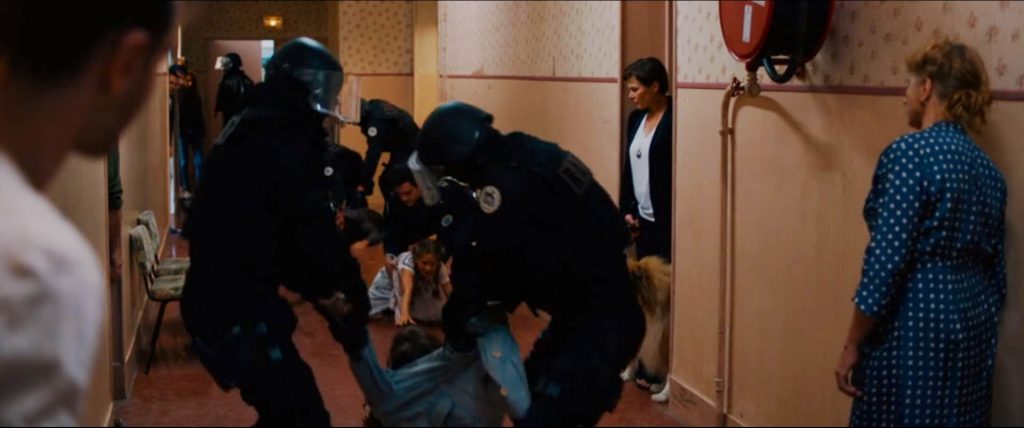
Abb. 6: Georg wird Zeuge einer Festnahme, Christian Petzold, Transit, 2018
Quelle: DVD, good!movies 2018
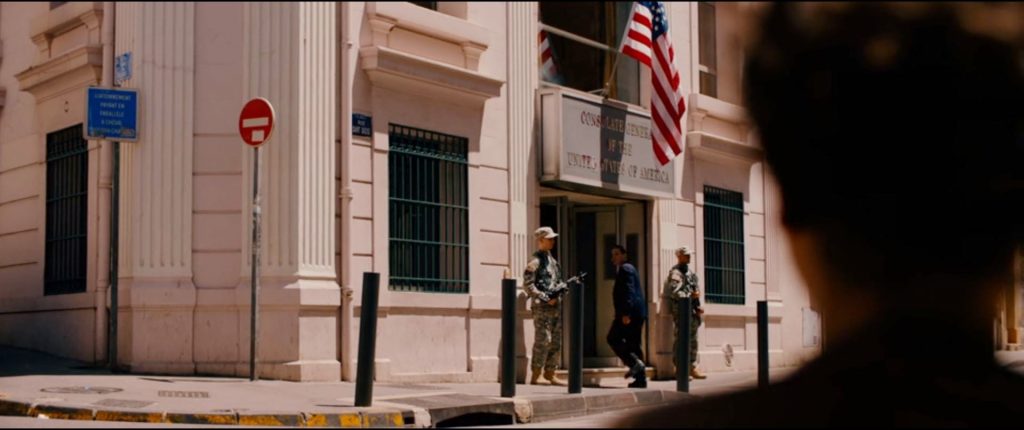
Abb. 7: Vor der amerikanischen Botschaft, Christian Petzold, Transit, 2018
Quelle: DVD, good!movies 2018
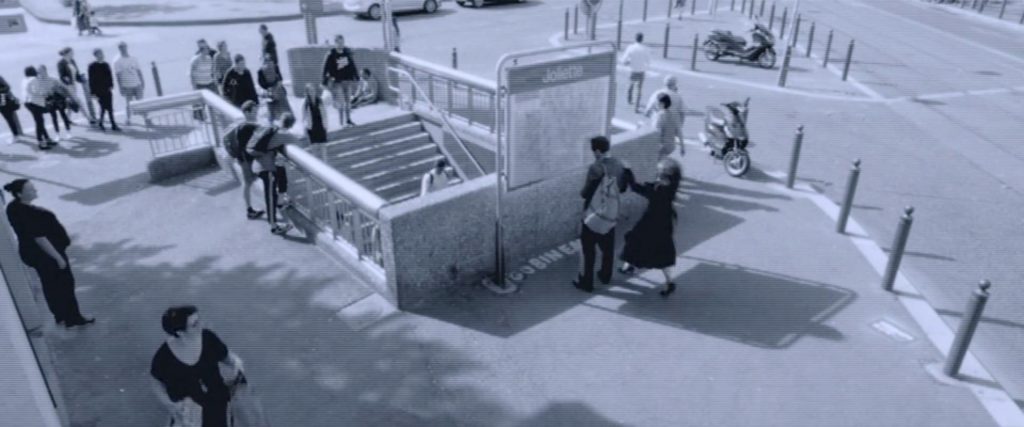
Abb. 8: Marie eilt zu Georg, den sie mit ihrem Mann verwechselt, Christian Petzold, Transit, 2018
Quelle: DVD, good!movies 2018

Atmosphäre entfaltet die Erzählebene des Films nicht zuletzt aus dem düster gefassten Typoskript des Schriftstellers und der Verzweiflung und Furcht, die aus ihm spricht. Dort ist von einem Mann zu lesen, der erst Tage und dann Jahre vor einem großen Tor wartete, bis er sich endlich an einen Passanten wendete: „Vielleicht können Sie mir helfen. Ich soll mich in der Hölle melden,“ „Aber mein Herr!“ entgegnet ihm schließlich der Vorübergehende, „Das ist die Hölle hier!“ Die Szene könnte in Kafkas Parabel Vor dem Gesetz ein Vorbild erhalten haben. Als sogenannte Torhüterparabel ist die Geschichte 1915 als Teil des unvollendet gebliebenen Romans Der Prozess veröffentlicht worden.12 Orson Welles hat die Erzählung in Verbindung mit einer Zeichentricksequenz in seiner Verfilmung des Kafka-Romans Le Procès (1962) in Szene gesetzt.13 Die vielen Hürden, denen sich der Protagonist dort gegenüberstehen sieht, werden durch Türen und Tore repräsentiert, die auch im übrigen Teil des Films jede menschliche Proportion verloren zu haben scheinen (Abb. 9).
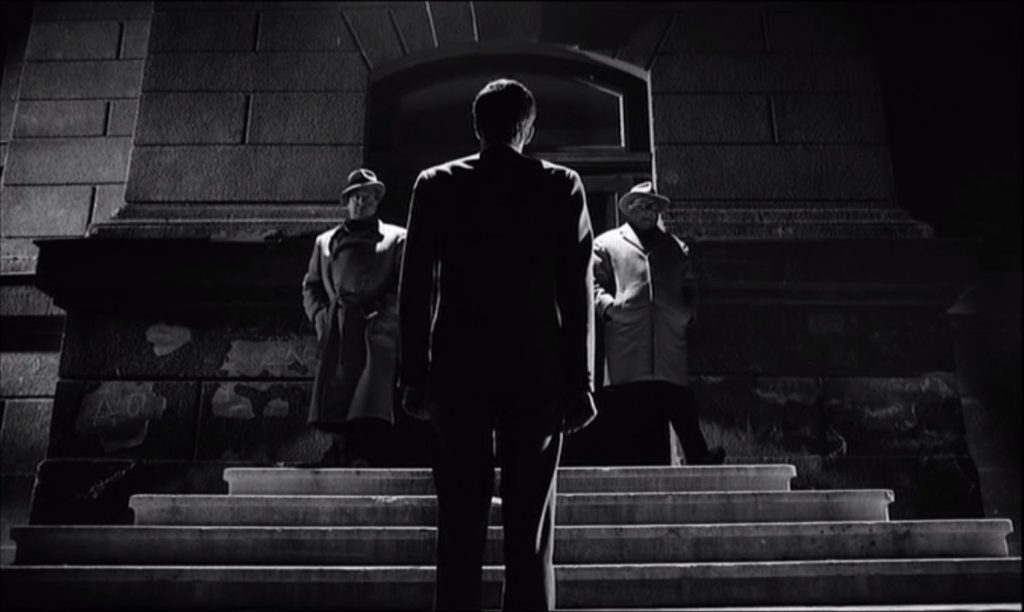
Abb. 9: Josef K. wird der Einlass verwehrt, Orson Welles, Le Procès, 1962
Quelle: DVD, Studio Canal 2012

Die Parabel handelt davon, dass ein „Mann vom Lande“ nie zum Gesetz gelangen wird, das ihn, repräsentiert in Form einer furchteinflößenden Architektur, vor die Mauern verweist. Unerträglich erscheint die Situation insbesondere durch deren offensichtliche Paradoxie: Das Tor steht zwar offen, aber der Türsteher, der sich als mächtige Gottheit ausgibt, verwehrt den Durchgang, nicht ohne gleichzeitig zu offenbaren, dass sich nach jeder Tür nur noch ein weiterer Saal mit einer weiteren Tür und einem weiteren Türsteher befände (Abb. 10). Das bleierne Warten, das der Pförtner einfordert, dauert letztlich genauso lang wie sich die restliche Lebenszeit des um Einlass Bittenden bemisst: eine für ihn auf ewig verlängerte Schwellensituation ohne jede Möglichkeit des Transits.14 Kurz vor dessen Tod eröffnet der Pförtner schließlich, dass er nun das Tor, das allein für den Wartenden geschaffen wurde, für immer verschließen werde. So surreal die Parabel erscheint, so real ist die darin angelegte „Farce“, die sich in der kafkaesken „Jagd nach Legitimationspapieren“, die durch die Historie belegt und durch das Buch von Seghers einmal mehr dokumentiert wurde, wiederfindet:

„Er hatte schon einmal einen Kontrakt besessen, auf den Kontrakt ein Visum, auf das Visum das Transit. Die Gewährung des Visa de sortie habe aber so lange gedauert, daß ihm inzwischen das Transit erloschen sei, darauf das Visum, darauf der Kontrakt. Letzte Woche habe man ihm das Visa de sortie gewährt, er warte jetzt Tag und Nacht auf die Verlängerung des Kontraktes die ja dann ihrerseits die Verlängerung seines Visums bedinge. Die aber sei die Vorbedingung für die Gewährung des neuen Transits.“15
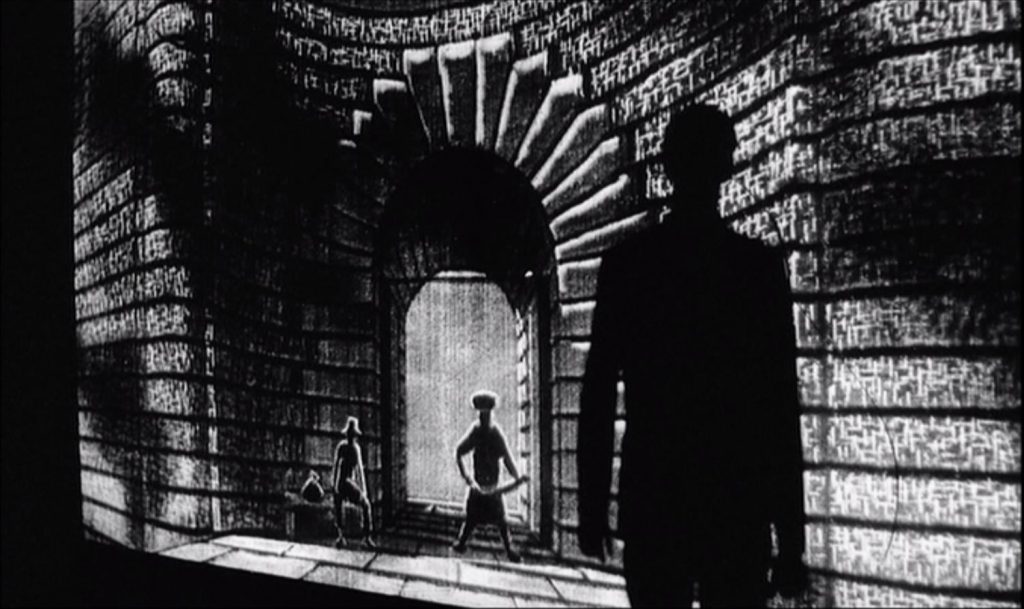
Abb. 10: Der Schattenwurf von Josef K. über den Projektionen nach Kafkas Torhüterparabel, Le Procès, 1962
Quelle: DVD, Studio Canal 2012

Auch in Petzolds Transit muss gewartet werden. Vor den Ämtern, in Wartezimmern und Treppenaufgängen bilden sich lange Menschenschlangen (Abb. 11). Als Georg im Konsulat endlich an den ungeduldigen Mitarbeiter im Vorzimmer gelangt, wird ihm mitgeteilt, dass erst geprüft werden müsse, ob er in das Zimmer des Konsuls weitergeleitet werden könne. Allein der Rang und die Bekanntheit des Schriftstellers, dessen Namen er sich angeeignet hat, eröffnen ihm schließlich einen privilegierten Zugang. Wie vielen Menschen das endlose Warten auf die richtigen Dokumente tatsächlich das Leben gekostet hat, lässt sich anhand der Vielzahl geschriebener oder aber ungeschrieben gebliebener Biografien nur erahnen. Auch in Petzolds Film werden Menschen von der zeitverzehrenden Warterei aufgerieben oder in Verzweiflung und Tod getrieben: Neben dem eigentlichen Schriftsteller und einem Komponisten (Justus von Dohnáni), der an Herzversagen stirbt, wird dort die Figur einer Architektin (Barbara Auer) entwickelt, die sich ausgerechnet vor der neuzeitlichen Kulisse des „Museums der Zivilisationen Europas und des Mittelmeers“ (MUCEM) in den Abgrund stürzt.
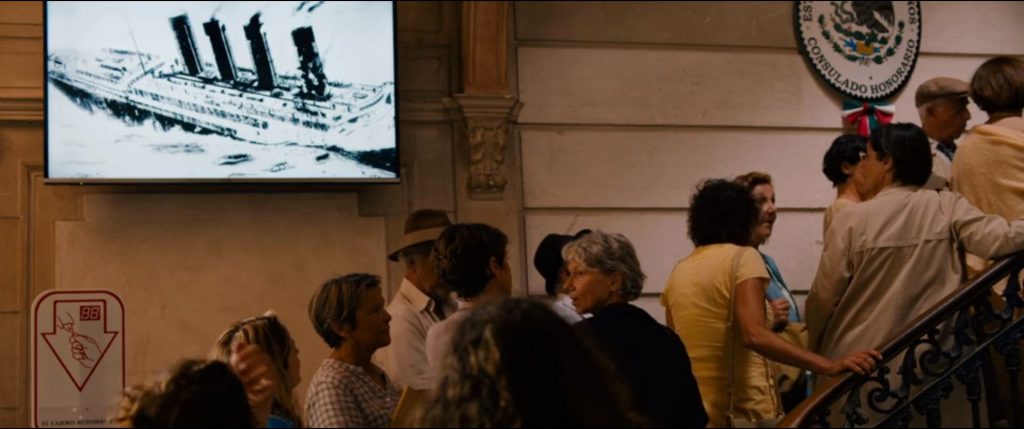
Abb. 11: Die Gegenwart des Historischen im mexikanischen Konsulat, Christian Petzold, Transit, 2018
Quelle: DVD, good!movies 2018

Aussichtslos erscheint auch jene Schwelle, an der sich Georg und Marie unüberwindbar gegenüberstehen. Die Hoffnung, ihren Mann doch noch wiederzufinden, hindert sie daran, die (vermeintlich) rettende Flucht über das Meer anzutreten. Gleichzeitig muss Georg an der Identität des Schriftstellers festhalten, um seinerseits seine Flucht und damit sein Weiterleben zu ermöglichen. Da Georg seine vorige Identität aufgegeben hat, muss Weidel am Leben bleiben, der so lange zwischen Georg und Marie stehen wird, wie diese mit ihrer Vergangenheit nicht abschließen kann. Deshalb wird Georg auf Schritt und Tritt von dem Phantom des Schriftstellers verfolgt, der sich so wenig abschütteln lässt wie sich ein Schatten vertreiben ließe. Denn überall dort, wo Georg seinen Namen nennt und die Papiere vorzeigt, wird Marie kurz darauf die Anwesenheit ihres Mannes bestätigt bekommen. Die Tragik der Erzählung besteht darin, dass sich die Indizien und Spuren, den Schriftsteller wiederzusehen, umso mehr verdichten je näher sich Georg und Marie kommen. Gibt Georg seine Verstellung preis, würde er sich auf Zeiten hinweg von Marie entfernen, der er sich doch gerade anzunähern versucht. „Wer vergisst schneller? Der Verlassene oder die, die ihn verlassen hat?“, fragt ihn der Konsul (Alex Brendemühl) im mexikanischen Konsulat, der ein zeitversetztes Gespräch zwischen Georg und Marie zu moderieren scheint. Erinnerungen und Lieder hätten nur die Verlassenen, wird Marie andernorts erzählen. Ihnen bleibe wenigstens das starke Gefühl der Melancholie, an dem sie sich festhalten können und das eben dadurch ihre Identität festige. Genau danach sehnt sich die rastlos Suchende, die den Schriftsteller verlassen hatte, um kurz danach wieder alles ungeschehen machen zu wollen. Doch ihr Brief hat den Schriftsteller nicht mehr rechtzeitig erreicht. Jetzt erscheint ihr allein die Erinnerung noch stark genug, um einen Halt zu vermitteln, den die Gegenwart nicht mehr bietet. Als Georg – der sich seiner Fluchtabsicht von Anfang an sicher war – das erkennt, bleibt ihm nur noch der Ausstieg. Das Taxi, das beide zum Hafen bringen soll, verlässt er unter einem Vorwand, der obwohl beiläufig daher gesagt dennoch etwas Wahres enthält: „Ich habe etwas vergessen … ich komme gleich nach.“ Vergessen und zurückgelassen hat er seine frühere Identität, gewonnen hat er aber eine Existenz, die das Janusgesicht der Verstellung und Lüge nicht länger akzeptieren möchte. Durch die Umstände in eine falsche Identität gedrängt, findet er zuletzt doch zur richtigen zurück.

Noch ein anderer Gedanke entspinnt sich aus dem Gespräch mit dem amerikanischen Konsul (Trystan Pütter). Georg wird befragt, ob er nach der Flucht über seine Erlebnisse schreiben würde und ob nicht gerade darin seine Rolle als Schriftsteller begründet sei. In Erklärungsnot greift Georg auf seinen eigenen Erfahrungshorizont zurück, der so stimmig erscheint, dass er auch von dem Schriftsteller selbst stammen könnte. In der Schule habe er immerfort Erlebnisse, die er in den Ferien und an den Feiertagen gesammelt hatte, zu Schulaufsätzen verarbeiten müssen, so als ob die Ferien bloß ein Vorwand wären, um Schreibanlässe zu generieren. Christian Petzold hat, wie es der aktuelle Umgang mit historischen Stoffen innerhalb der deutschen Filmlandschaft durchaus hätte nahelegen können, weder einen Schulaufsatz noch einen Lehrfilm hergestellt. Eine Lehre im Sinne einer in die Gegenwart weisenden Parabel ist dennoch in ihm enthalten.

„Im Gewand der historischen Begebenheit“, schrieb Farocki, berge der Roman von Seghers das Material für eine Parabel. Eine interessante Formulierung, die das Historische nicht durch Kostüm, Verkleidung und Verstellung definiert, sondern durch „Begebenheiten“, die bis in die Gegenwart vordringen können. Den identitätszersetzenden Transitzonen, den Ämtern, Lagern und Grenzstreifen sowie dem dumpfen Gefühl der Bedrohung werden in Transit alternative Erzählungen zur Seite gestellt, die der Anonymität der Verallgemeinerungen widersprechen, wie sie in der erregten Berichterstattung gegenüber aktuellen „Begebenheiten“ vielmals kolportiert werden.


1 Anna Seghers, Transit, Berlin 2017, S. 45.

2 Seghers 2017, S. 47f.

3 Der Film feierte am 5. April 2018 seine Deutschlandpremiere. Am selben Tag hat Volker Pantenburg das Dokument mit der Notiz Farockis online gestellt, siehe: Volker Pantenburg, Harun Farocki über TRANSIT (1966), in: new filmkritik, 5. April 2018, URL: http://newfilmkritik.de/archiv/2018-04/harun-farocki-ueber-transit-1966/ [8. April 2018]. Dieser Aufsatz ist unmittelbar daraufhin entstanden und wurde für die vorliegende Veröffentlichung ergänzt.

4 Aus einem Brief von Jeanne und Kurt Stern geht hervor, dass Seghers den Roman offenbar noch während der Zeit ihrer Überfahrt nach Mexiko begonnen hatte: „Seghers verließ mit ihrer Familie auf einem Frachtschiff Marseille im März 1941 und erreichte im November 1941 Mexiko“, schreibt Sonja Hilzinger im Nachwort der hier verwendeten Ausgabe (Seghers 2017, S. 278). Laut Hilzinger ist der Roman 1944 zunächst auf Spanisch erschienen und lag erst 1948 in deutscher Fassung vor. Die Aussicht sowie konkrete Erfahrungen ihrer Flucht hat Seghers zudem in Reise ins Elfte Reich (1939) sowie in der Erzählung Das Obdach (1941) verarbeitet.

5 Zehn Jahre später unternahm die Filmregisseurin Ingemo Engström, mit der Farocki zuvor für einige Filmprojekte zusammengearbeitet hatte, zusammen mit ihrem Mann Gerhard Theuring entlang des Fluchtwegs von Paris bis Marseille mehrere Recherchereisen. Unter Einbezug des Romans von Seghers, dem Arbeitsjournal von Bertolt Brecht, Texten und Briefen von Walter Benjamin sowie einem Gespräch mit Alfred Kantorowicz entstand dann 1977 der von Engström und Theuring gemeinsam fertiggestellte Recherchefilm Fluchtweg nach Marseille. Bilder aus einem Arbeitsjournal. Siehe dazu die nachgereichte „Chronologie einer Filmreise“ in der Ausgabe der Filmkritik, 22. Jg., 1978, H. 2, S. 66 – 97.

6 Dass Farocki diesem Narrativ auch aus anderer Perspektive nachhing, zeigt eine spätere Formulierung, die im Hinblick eines filmhistorischen Streiflichts auf das Motiv der vertauschten Frau, getroffen wurde: „Und dann muß die falsche Frau etwas von dem Leben der richtigen fortführen. Aus der Schein-Identität wird gefühlte Wirklichkeit. […] Daß ein Mensch in den Umriß des anderen tritt und damit etwas von dem Leben des anderen leben muß: das ist als Idee zu gut, um leicht eine gute Geschichte zu werden.“ Harun Farocki, Vertauschte Frauen, in: Filmkritik, 24. Jg., 1980, H. 6, S. 274 – 297, hier S. 275, 277.

7 Cornelia Geißler, „Heimat fordern die, die andere nicht reinlassen“, Interview mit Christian Petzold, Berliner Zeitung, 2. April 2018, URL: https://www.berliner-zeitung.de/kultur/film/interview-mit-christian-petzold–heimat-fordern-die–die-andere-nicht-reinlassen–29942202 [17. April 2018].

8 Geißler / Petzold 2018.

9 Das entgegengesetzte Motiv findet sich in Phoenix, wo die Ähnlichkeit der Rückkehrerin mit der totgeglaubten Nelly (Nina Hoss) zwar unübersehbar ist, ihre Identität jedoch, selbst von Johnny (Ronald Zehrfeld), ihrem einstigen Mann, nicht (an-)erkannt wird. Wie bei Transit geht auch die Idee für Phoenix auf einen Vorschlag seitens Farocki zurück. Dabei handelt es sich um den Roman Der Asche entstiegen (1961, frz. Le retour des cendres) von Hubert Monteilhet. Wertvolle Hinweise zu den Filmen Petzolds finden sich in einem jüngst erschienenen Sammelband, in dem Transit jedoch nicht mehr berücksichtigt werden konnte. Für den Nachweis der Romanvorlage in Phoenix siehe ebenda: Jaimey Fisher, Petzolds Phoenix, Fassbinders Maria Braun und die filmische Archäologie der Nachkriegszeit, in: Ilka Brombach/Tina Kaiser (Hg.), Über Christian Petzold, Berlin 2018, S. 191 – 212, hier S. 199.

10 Glasers 1951 verfasstes und erst 1989 auf Deutsch erschienenes Werk in zwei Bänden Geheimnis und Gewalt (frz. Secret et violence. Chronique des années rouge et brun (1920 – 1945)) nennt Petzold dann auch als eine weitere wesentliche Quelle für die Erarbeitung des Drehbuchs. Farocki hat 1988 mit seinem Film Georg K. Glaser – Schriftsteller und Schmied ein eindrucksvolles Porträt Glasers vorgelegt (Erstausstrahlung am 20. September 1988, SWF 3).

11 Geißler / Petzold 2018.

12 Zu Lebzeiten Kafkas wurde die Erzählung dann in die Textsammlung Ein Landarzt (1920) aufgenommen. Franz Kafka, Vor dem Gesetz, in: Wolf Kittler, Hans-Gerd Koch und Gerhard Neumann (Hg.), Ein Landarzt, Frankfurt am Main 2002, S. 267 – 269.

13 Die im Pin-Screen-Verfahren hergestellte Prologsequenz haben der französische Zeichentrickpionier Alexandre Alexeieff und Claire Parker hergestellt. Für die spätere Fassung des Films wurde die Prologsequenz jedoch weggelassen. Geblieben ist die Sequenz zum Ende des Films in der Josef K. (Anthony Perkins) in einem Diavortrag mit den Bildern von Alexeieff und Parker konfrontiert wird, während ihm der Advokat (Orson Welles) die Geschichte erzählt. Für Hinweise danke ich Jens Meinrenken.

14 Insbesondere unter dem Aspekt des ewig verlängerten Aufschubs hat sich auch Derrida mit dem Text Kafkas beschäftigt. Die Nicht-Ankunft, das heißt die Nicht-Begegnung von Gesetz und Individuum, ist dort zugleich der Anfang der Literatur wie das Ende des Gesetzes. Siehe Jacques Derrida, Préjuges. Vor dem Gesetz, Wien 1992.

15 Seghers 2017, S. 45. Über Seghers’ Reise ins Elfte Reich, schreibt Hilzinger im Nachwort von Transit: „Die Sammlung von neun kurzen Prosastücken […] gestaltet Alltagserfahrungen von Emigranten auf humoristisch-skurrile Art, verfremdet im Grundmotiv der verkehrten Welt. So ist die wichtigste Voraussetzung für die Einreise in das phantastische Exilland, keine Papiere, Pässe und Visa zu besitzen […].“ Ebd., S. 279.
Posted in Ausgabe 15, Buchrezensionen | Tagged , , , , , , , , , , , , , , , | Comments Off on Die Gegenwart des Historischen in Christian Petzolds Transit

Editorial

Since our first issue in 2011 all-over has evolved from a student project to a peer-reviewed journal, always committed to open access, critical curiosity and supporting emerging scholars. Every issue featured an artist, who engaged with the specificities of the online magazine as a medium and our publishing approaches. Eponymously,

all-over aimed to be a magazine for art and aesthetics: contributing to a wide discourse, addressing artistic and scientific questions related to historic and contemporary art.

Now, after eight years, we bring this project to a close. The end of an era tends to bring out an “archival impulse,” as Hal Foster put it when analyzing contemporary art practices after modernism. In view of its distinctive and thus pervasive character Foster calls this impulse a tendency in its own right: “At a time when – artistically and politically – almost anything goes and almost nothing sticks,” all our 15 issues as well as 15 editorials, 49 articles, 27 reviews, 13 interviews and 14 artistic contributions will remain accessible in our online archive. Could one translate the quintessentially non-locatable online archive as Foster’s ultimate non-place of utopia that becomes not only a place of return for the belated but also a departing point for new becoming – a new form of discourse?

For this issue, Sebastian Mühl examines the critical potential of historiographical tendencies in contemporary art: Drawing on archival art works, such as Tacita Dean’s Bubble House, Mühl questions the universalist character of modernist utopias rather than perpetuating their ideals. In regard of the “historiographical turn”, Mühl outlines specificities of a post-utopian approach to the archive and discusses the artwork’s entanglement with models and matters of history.

In a different approach to the historiographic mechanisms in Western art, Sophie Publig examines indigenous artist Beau Dick’s contribution to documenta 14. Dick’s exhibited masks took a double role as art object as well as ritual object within the center of the contemporary art arena and challenged not only paradigms of exhibition making: based on the controversial discourse that this display has initiated, Publig questions the inadequate system of contemporary art terminology and the predetermined set of rules for inclusion or rather exclusion that comes along with an aesthetic canon of the western art history.

The reactivation of historical material and its adaption to the contemporary plays a key role in Thomas Helbig’s contribution The Presence of the Historical in Christian Petzold’s Transit – a multilayered investigation of temporalities and their respective transitoriness or revivification in filmmaking. Helbig views the film as a parable in which histories of emigration are transferred from the times of fascism to the present and unfolded in contemporary conditions, while the Kafkaesque farce of denied access at allegedly open doors remains unchanged.

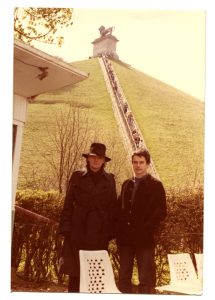
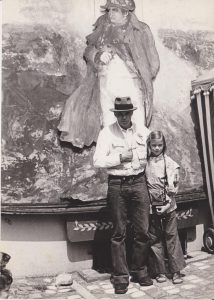
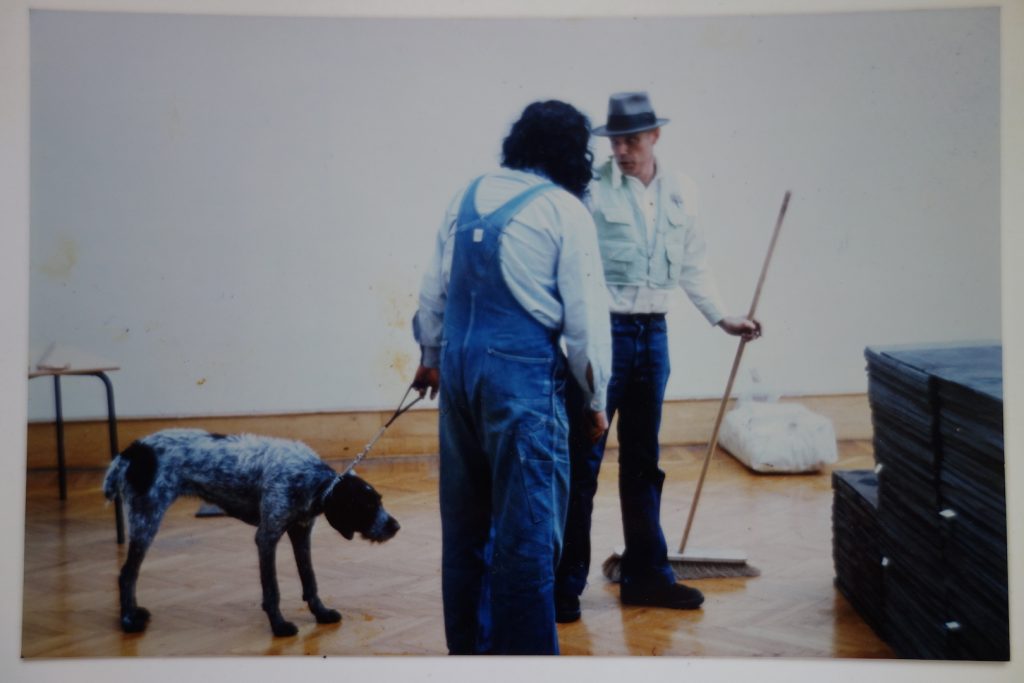
Repetition and remembrance are also at the heart of the interview with art collector Isi Fiszman and historian Bernard Coppens that Lotte Beckwé conducted for all-over. For their conversation, the parties travelled to Waterloo – the historical site of Napoleon’s last disastrous battle. Both, Fiszman and Coppens have visited the site before, in the 1970s when they took artists like Marcel Broodthaers, James Lee Byars and Joseph Beuys to visit the place with its lion monument. We publish the records of their re-visit in honor of Isi Fiszman, initiator of the artist’s Waterloo-tourism, who, unfortunately and untimely, passed away not long after the conversation was held.

Amongst the many men of letters whom Broodthaers honored and referenced in his artworks, was the French poet Stephane Mallarmé. In an artist’s book of 1969, Broodthaers republished Mallarmé’s poem Un coup des dés with all the words replaced by black bars, thus drawing attention to the arrangement of space and words in the poem. In her essay Verssuche, Stefanie Heinzl analyzes the poetic structures in Mallarmé’s spatial arrangement of words pointing out his sustained interest in the connections and breaks between the visible and audible character of language. 

In his double-review, Steyn Bergs taps into another area of the visualization of sound: two exhibitions, w serves imperialism at w139 in Amsterdam and Kunsthalle for Music at Witte de With in Rotterdam, set out to present artworks and artistic practices, which employ music and sound: How can art institutions host, present, represent music? Taking into account matters of attention and institutionalized manners, Bergs presents a political reading of (art) institutions and their transpositional potentials. 

In our last all-over-picture-spread artist Travis Wyche tests the potentials and limits of artistic interventions by giving up a dedicated space within the magazine and instead intervening in the production process of this issue. His interference defies a predetermined space but permeates our final publication, as he already accompanied us through the publishing process. His participation also resulted in a visual representation of the relations of the many entities at work in the creation of an issue of all-over.

Behind all of these entities stand persons: our authors and artists, our graphic designers and peer-reviewers, our readers and our hosts – all of which have contributed to make this magazine what it is. And even though all-over is all over we hope the discussions will continue on all sides.

Our thanks go to all contributors, to former editorial member and co-founder Dominique Laleg, and especially to our graphic designers Michael Hübner (Issue #2 – Issue #8) and Boah Kim (Issue #9 – Issue #15) for their tireless creative input. Last but not least “thank you” to our readership, that has grown over the years and given us reason to continue this unique project. Once again, we wish you a good read!

Hannah Bruckmüller, Jürgen Buchinger, Barbara Reisinger, Stefanie Reisinger

Posted in Ausgabe 15, Editorial | Comments Off on Editorial

Institutional Transpositions

It is not that we never had music or sound-based work in our museums and art galleries before. Although the following account brackets, for the sake of expediency, the entire history of music’s prior excursions into institutions of visual art as well as of music’s entanglements with the visual arts more generally, the claim here is not that there is anything particularly new about music moving into art spaces. Nor is the present text animated by the desire, often typical of art criticism, to detect, articulate, and possibly evaluate a certain tendency or artistic ‘trend’. Rather, the point of this text is to bring into a constellation two exhibitions to which music was crucial, and which experimented in different ways with inserting music into institutional contexts commonly reserved for contemporary visual art. In doing so, it will be argued that for all their apparent differences, these two exhibitions—Kunsthalle for Music at Witte de With in Rotterdam and w serves imperialism at W139, Amsterdam—shared certain structural features and underlying concerns, and thus resonate with one another. More specifically, the emphasis will be on how both exhibitions experimented with the duration of reception, with the question of who exerts control over this duration (the viewer or the makers of the work and the exhibition), and finally with attention and distraction. More specifically still, these exhibitions’ organization of temporality and experience will be read against the backdrop of our 21st-century attention economy, in which content becomes abundant and ubiquitous, and attention becomes a scarce commodity as a result. Sensing an urgency therein, the parallel reading of these two exhibitions of music—the time-based art par excellence—will illuminate the relations between art institutions and the temporal economies of exhibitions on the one hand, and the attention economy on the other.

Kunsthalle for Music

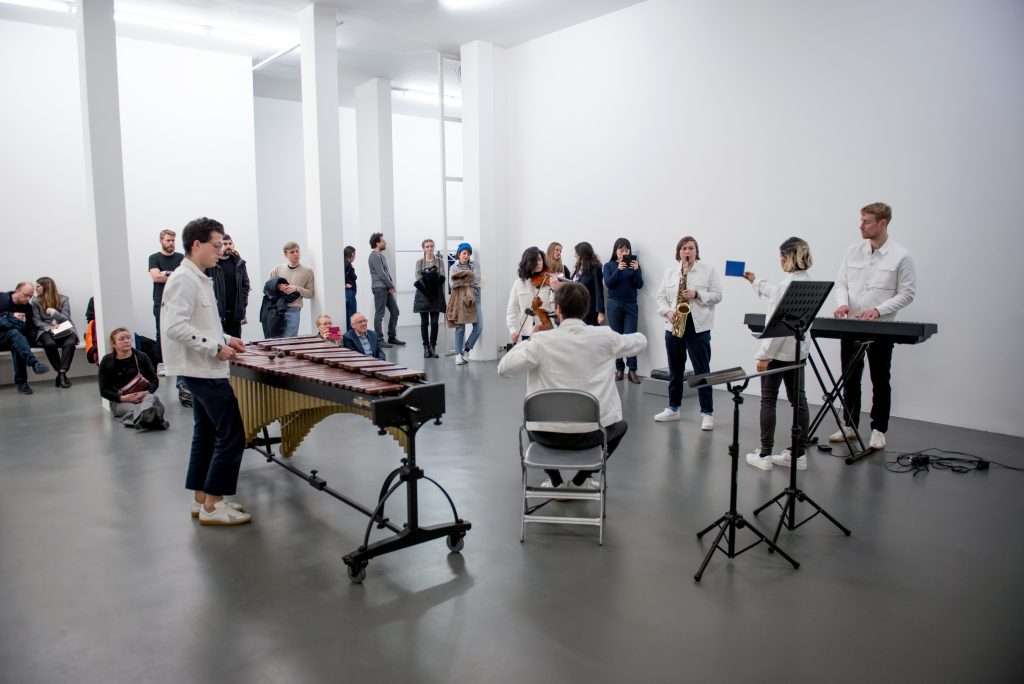
Fig 1: Opening Kunsthalle for Music on Thursday 25 January 2018 at Witte de With Center for Contemporary Art, Rotterdam.
Photographer: Nieuwe Beelden Makers.

“Music is not necessarily what you think it is,” proclaims the opening of a manifesto penned by Ari Benjamin Meyers, artistic director of Kunsthalle for Music, initiated by Meyers himself in collaboration with the Witte de With centre for contemporary art in Rotterdam and the Hong Kong-based organization Spring Workshop. The project’s stated aim, then, was to explore and push the boundaries of what we commonly understand music to be. Much like Meyers’ manifesto, the exhibition that took place in Witte de With from January 28 until March 3, 2018, revealed a desire to break away from certain conventions that appear as near-inextricable from dominant tendencies in Western music. Such conventions include the ritual character of the concert or musical performance; the separation, in the social situation of the performance, between an audience and a group of specialized performers or interpreters; the notion that an interpretation or recording is supposed to be faithful not only to the musical score but also to certain conceptions of what is supposedly essential in a specific piece or a specific genre of music. Kunsthalle for Music wanted to (re-)ground music in the everyday, as an embodied experience and lived practice.

As this description reveals, the specter of the avant-garde loomed large over the project—with the (neo-)avant-garde’s musical experimentations, and particularly those of post-Cagean Fluxus, serving as the most apparent point of reference for the project.1 This is furthermore underscored by the articulation of the Kunsthalle’s founding principles in a manifestoan avant-garde form par excellence. In Peter Bürger’s influential theorization, the historical avant-garde aspired to achieve a fusion of art (or music) and life, a fusion that would ultimately amount to the sublation of art as an institution.2 According to Bürger’s account, the crux of the historical avant-gardes was essentially a radical de-institutionalization of art.3 After all, the historical avant-gardes considered the institution of art a mere by-product of bourgeois ideology, and saw art’s institutions as practico-inert even in respect to this already regressive ideology. The Kunsthalle for Music’s reminiscences of the avant-garde, then, rendered all the more conspicuous the fact that the project proposed not such a de-institutionalization, but rather a transposition of music to the institutional contexts and dispositifs specific to contemporary visual art—specifically, the context of the Kunsthalle, a typically post-war institutional space that is invested in the mounting of temporary exhibitions and does not collect or preserve any works of art.4

Fig 2: Opening Kunsthalle for Music on Thursday 25 January 2018 at Witte de With Center for Contemporary Art, Rotterdam.
Photographer: Nieuwe Beelden Makers.

During the course of the exhibition at Witte de With—for which the entire art centre was in fact temporarily renamed the Kunsthalle for Music—four musical live performances took place every week. The repertoire consisted of music and of other pieces “based on music”—mostly performance works with some musical component to them. It included pieces by composers such as Charles Ives, but also by characters we mostly associate with the visual arts, from Marcel Duchamp via John Baldessari to Laure Prouvost. A small number of pieces were newly commissioned; works by Jonathan Bepler, Libia Castro & Ólafur Ólafsson, Dominique Gonzalez-Foerster, and The Residents. The repertoire was interpreted by the Kunsthalle for Music Ensemble, which was formed especially for the occasion of the exhibition and consisted of eight musicians and performers with different disciplinary backgrounds, interests, and fields of expertise. The selection and order of the pieces executed by the ensemble was different each time; each visit and each performance were therefore unique. It is not an exaggeration to state that attending the Kunsthalle for Music differed radically from the standard concert experience—and that includes performances of experimental music and avant-garde pieces. Witte de With’s two-storey exhibition space was used in its entirety; with the members of the ensemble scattering through the rooms, congregating for a certain piece, then scattering again. More than anything, the musical experience in the Kunsthalle was designed to feel “informal” as—contrary to the standard concert situation—visitors could enter and leave freely during the duration of the performance and walk around unimpededly as performances were ongoing.

The scare quotes embracing the word “informal” prove necessary here: the experience of informality in the Kunsthalle was not so much the result of a fusion of music with everyday life—a fusion that, as a perhaps caricatural version the avant-garde would have it, would render music formless to the point of becoming unrecognizable. Rather, it was a more or less logical consequence of the fact that most visitors, presumably, were not (yet) accustomed to finding live music being performed in institutional contexts commonly reserved for contemporary art—institutions that we associate with certain experiential and attentional forms, and certain modes of reception. What occurred here was not a de-institutionalization of music, but rather its transposition from one institutional context to another. In other words, music was extrapolated from its usual, traditional framework, and thereby, to some extent, temporarily rescued from some of the reifications that this institutional framework brings about. At the same time, however, it was also subjected immediately to a different set of institutional codes and conditions—those of the contemporary art world—not at least because these codes and conditions are embodied and internalized by the visitors of Witte de With, who entered the premises carrying with them a specific set of institutional habits.5 In that respect, it was telling that the Kunsthalle for Music could also be visited during Witte de With’s regular opening times, when no live performances were taking place. First and foremost, visitors then encountered—apart from a number of musical instruments, some musical paraphernalia, and a small number of artworks and wall labels—the radiant emptiness of the white cube itself. And indeed, it was this dispositif that was made to shine with the promise of emancipating music from the institutional reifications with which it has arguably become all too merged.

Such a promise is to be taken seriously, but also with a grain of salt. An illuminating historical analogy is offered here by the so-called documentary turn in art that, in a not too distant past, sought to do away with some of the conventions crusted into the genre of documentary film, and to do so specifically by moving film away from cinema, and into the art world.6 The documentary turn effectively amounted to an explosion of interesting work that approached documentary film-making in a new way. Yet, it also demonstrated the speed and ease with which the contemporary art world absorbs the shocks of the new—shocks which in fact keep its machinery running. Moreover, this analogy with the documentary turn is valuable because, in the case of the documentary turn, too, it was specifically the temporal structure of the museum experience that was credited with a certain emancipatory potential. As the visitor could move around freely through the exhibition space, it was no longer exclusively the duration of video works that determined the duration of reception.7 Another, still more recent point of reference could be the surge of experimentation with dance performances in visual art institutions.8 In these cases, as in the Kunsthalle, the individual museum-going subject’s power to determine the duration of their own processes of attentive contemplation is pitted against the traditional immobilization of audiences and spectators in concert halls, theatres, and cinemas, where the time of reception is carefully administered. This is an operation that will succeed at catching exhibition-goers off guard for as long as they remain unaccustomed to these newly proposed modalities of reception, but a revolutionization (of documentary film, of dance, of music) it is not—nor, we might perhaps add, does it need to be.

Kunsthalle for Music’s informality, as well as its intended problematization of the “ontology” of music, consisted first and foremost of subjecting music to the diffuse and scattered forms of reception normally reserved for visual art.9 And indeed, this move did result in an a-typical, “fresh” musical experience. In that sense, this undertaking can be considered a generative experiment with strategies of reframing and recontextualization—in particular, with what has been called here the institutional transposition of music. At the same time, one does not need to adhere to an obstinate and conservative cultural pessimism to see that it also effects a certain loss, a certain impoverishment of musical experience. It is true that the institutional dispositif of the Kunsthalle for Music did not impose the rigid, passive, and petrified form of contemplation still commonly associated with “high” culture in the same way as, for example, a classical concert set-up does. An important point, however, is that it is precisely this abandonment and this “informality” that makes the Kunsthalle (and the white cube in general) the institutional format most conveniently in synch with our 21st-century attention economy, characterized as it is by an abundance of content (text, image, sound, information) and a relative scarcity of our human attentive capacities—our potential to stay interested, to process, and ultimately to care.10 Everyone who visits art exhibitions regularly will be well-familiar with the blasé attitudes they can often foster, and is therefore likely to be skeptical about the supposed emancipatory potential of the museum or exhibition space for music.11 Nonetheless, it will prove fruitful here not to settle on any final conclusions—let alone judgments—on the project quite yet, and to instead move on to a discussion of an exhibition that was in many respects dissimilar and dissonant to the Kunsthalle for Music, yet was underpinned by some of the same concerns and engaged in a related experimentation with the duration of reception, with the “freedom” and sovereignty of the exhibition-goer, and with questions of attentiveness and distraction.

w serves imperialism

Fig. 3: Opening of w serves imperialism, Friday 15 December 2017 at W139, Amsterdam, with an “opening-specific” audiovisual installation by Jonathan Mikkelsen.
Photographer: Chun-Han Chiang.

w serves imperialism was on view at W139, an artist-run project space in Amsterdam, from December 15, 2017, till January 21, 2018. Conceived and curated by W139 members and artists André Avelãs and Anami Schrijvers, it featured sound, video, installation, and music pieces by Avelãs himself, James Beckett, Cornelius Cardew, Nicolas Collins, DNK-Ensemble, Gijs Gieskens, Experimental Jetset, Joseph Kudirka, Brian McKenna, Jonathan Mikkelsen, Koen Nutters, Mike Ottink, Tristan Perich, Gert-Jan Prins, Natalia Domínguez Rangel, Paulo Raposo, Jasna Veličković, and Bas van Koolwijk. None of these pieces hinged on an element of live performance, nor were they, in and of themselves, pieces of music: most were installations, mobiles, or video works in which the sound component was particularly pertinent.12 Much like Kunsthalle for Music, the exhibition looked to the avant-garde for inspiration, albeit a somewhat different avant-garde. While Ari Benjamin Meyers referred to (neo-)avant-garde musical practices more generally, the makers of w serves imperialism looked specifically to the aforementioned figure of Cornelius Cardew. A composer initially influenced strongly by Cage, Cardew pioneered musical experiments with noise and improvisation before becoming increasingly involved with Marxist-Leninist politics. These political inclinations would quickly lead him to not only give up composing avant-garde or experimental music, but also to condemn it as elitist. He started composing in a more accessible idiom, often drawing on folk and popular music and writing in the service of the party. He denounced the musical avant-garde as well as his prior engagements with it in his scathing book Stockhausen Serves Imperialism—the source for the title of the W139 exhibition.13

In Kunsthalle for Music, issues relating to the temporal structure of the exhibition experience and its implication in the attention economy were ever-present yet nowhere explicit; they served as the background against which the insertion of music in the exhibition space could stand out as novel and singular. By contrast, w serves imperialism was emphatic about bringing these issues to the fore. The accompanying exhibition text made clear reference to the attention economy and its ramifications for how we experience art and exhibitions:

The current state of media consumption renders us subjects of a sinister attention economy, making multitasking and superficial scrolling norms. This is the manner in which we often move through exhibitions as well, supposedly browsing art with a mere 9 seconds dedicated per artwork. With w serves imperialism, we seek an antithesis, a conceptual approach of curating conscious and qualitative art experiences that provides the time and space to engage in-depth.14

This antithetical proposition vis-à-vis the attention economy was nothing if not radical. The exhibition’s visitors would enter W139’s exhibition hall through a black curtain, to find the entire space shrouded in a pitch-black and disorienting darkness. Though no wall texts were present to warn visitors about what to expect, the exhibition’s structure would reveal itself soon enough. Essentially, the various artworks in w serves imperialism were subsumed into one single installation, a unified Gesamtkunstwerk that employed an intricate technical system to illuminate and activate the works in the show: when a given work was lit and operative, all others would be utterly invisible and mute. The various pieces in the exhibition, therefore, could only be experienced one by one, in the order mandated by the exhibition itself. They were not always shown in the exact same sequence, though, and sometimes a specific work was turned on more than once in one exhibition “cycle”. Thus, the duration of reception here was dictated by the exhibition structure rather than by the visitors themselves. This was the case not only for the individual artworks, but also for the exhibition as a whole—which took about 1,5 hours to consume, if one wanted to see every work at least once. Though not at all unpleasant, the experience of visiting w serves imperialism was one of giving up control and submitting oneself entirely to the exhibition’s dispositif, to its carefully composed program of stimuli. In its use of shock tactics as well as of subtlety, this program was extreme: some works were deafening, others barely made a whisper; certain pieces would form a stroboscopic attack on visitors’ eyesight—severely sensitized by the obscurity of the exhibition space—while some were so scantly lit that they were hard to even locate in the darkness. Needless to say, this was a firm curatorial setup if ever there was one: not only did it impose a specific rhythmic pattern of reception on its visitors, but it required that the participating artists had to agree to an exhibition format in which their work would in fact be invisible and inaudible for most of the time. In Leninist politics such as Cardew’s, liberation and emancipation are to be achieved by giving oneself over to the programmatic stringency of the party, effacing one’s individual desires and particularities to better meet the exigencies of the revolutionary horizon. Somewhat analogously, the proposition of w serves imperialism was that subsumption into the machine-like and rather relentless apparatus of this total installation, while suspending the sovereignty of the exhibition-goer to control the time of contemplation, would ultimately enable a deeper, more qualitative attentive engagement with art.

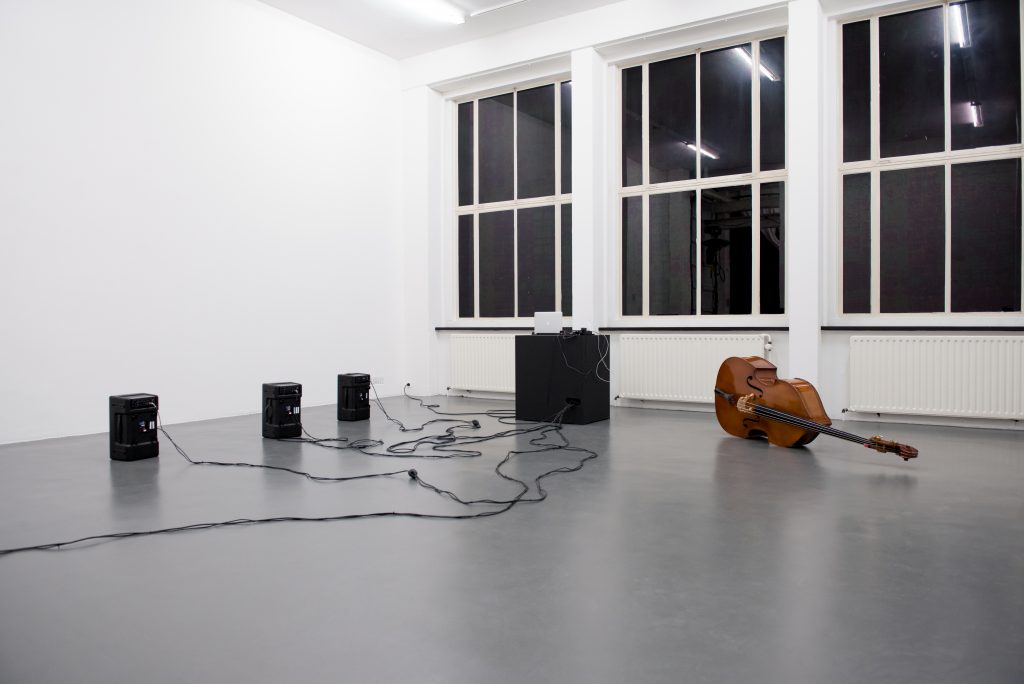
Fig. 4: Installation view of <em, 16 December 2017 – 21 January 2018 at W139, Amsterdam, with: Paulo Raposo, Three Wind Drawings (Part IV of _Chronomatopeias Series_), 2017.
Photographer: Chun-Han Chiang.

In several ways, then, w serves imperialism functions as a perfect counterpoint to Kunsthalle for Music. Where musical performances in the first exhibition reveled in the brightness of the white cube—a luminosity that has always functioned ideologically as a cipher for a certain faith in the public sphere, for transparency, and ultimately for Enlightenment itself—the second created what Noam Elcott has termed artificial darkness, establishing an affinity with the experiential forms associated with cinema and the theatre or concert hall, rather than with traditional exhibition spaces.15 While Kunsthalle visitors roamed freely through the exhibition space, their itinerary through w serves imperialism was largely predetermined. While the former exhibition was predicated on notions of informality, improvisation, and play, the latter mounted a highly rigid structure. The scattered, distributed distraction of the Kunsthalle diametrically opposed w serves imperialism’s commanding centralization and concentration of attention. Simultaneity in the Kunsthalle became sequence in w serves imperialism; chaos became order. Ultimately, they were two very different but complementary institutional transpositions: whereas the Kunsthalle kept the attentional modality of the exhibition space intact, seeking to explore how music would function and transform under its conditions, w serves imperialism was ultimately more invested in challenging and overhauling those conditions, with the quintessentially temporal and durational nature of music serving as a model for doing so. Even though visitors could of course still leave the exhibition at any given point, or just roam through the darkness as they desired, disregarding the switching-on and switching-off of works, it is not an exaggeration to state that w serves imperialism, in bargaining away some of the viewers’ autonomy over the time of reception, began to move away from the institutional framework of the art exhibition, toward that of the concert. Though the exhibition contained no musical pieces—at least not in any conventional understanding—its arrangement was musical in that it aligned the duration of successive pieces with the attention paid by its visitors.16 While the Kunsthalle set out to demonstrate that music is not necessarily what we think it is precisely by moving away from the concert setting and inserting music into an art institutional context, in w serves imperialism it was the institutional context itself that was transfigured through music. It is in this sense that the exhibition was radical: it challenged certain deep-rooted presuppositions of what an exhibition is, and of what forms of experience it affords. It did so specifically by tampering with the freedom visitors are accustomed to having over their time in the exhibition space, and with the distracted reception this freedom more often than not results in.

On an imagined spectrum of attentive modalities, from hyperdistracted to hyperconcentrated, these two exhibitions would have to be situated at opposite ends. However, simply presenting them as antithetical and contradictory to one another would ultimately be reductive. In their ways of organizing duration and attention, the Kunsthalle and w serves imperialism present diverging responses to the attention economy and the challenges it poses for cultural experience. It is important to grasp both responses at once, and dialectically, as both have their own merits as well as their shortcomings when it comes to facing those challenges. Clearly, the issue with the former is that it rather uncritically employs the institutional frame of the exhibition as an instrument for emancipating music and musical experience, neglecting this institutional frame’s increasing entanglement with the attention economy altogether. With the latter, which does explicitly address issues of attentiveness, the trouble is not so much with its “authoritarian” tendencies (lest we forget that authoritarian exhibition concepts are still a far stretch from authoritarian states) as with its cursory acceptance of the presumption that “conscious and qualitative art experiences” and “in-depth” engagements are intrinsically desirable or superior. As even a quick glance at the passage of Benjamin’s Artwork essay referred to above reveals, such a presumption—though admittedly it acquires new implications under the attention economy—is not without its ideological and arguably elitist connotations. Furthermore, keeping the dialectical tension between these two shows in suspension proves helpful in avoiding overly schematic or totalizing understandings of the attention economy (and the ubiquitous and tiresome complaints concerning the supposedly microscopic attention spans of “millenials” certainly demonstrate how tempting such simplifications are), or of what an appropriate rejoinder to it might entail in the field of culture.

Finally, it should be made explicit that throughout this account, questions of control and sovereignty over the time of spectatorship have figured metonymically for struggles over time in general, and therefore ultimately for politics itself. Different attentive modalities, from the dispersed to the concentrated, have been correlative to different political forms, from the molecular revolutions of individual liberation to the regimented organization of party politics. When it comes to these political forms, too, apprehending seeming opposites dialectically seems more productive than seeing them as mutually exclusive of each other. It can be a way of keeping things open, of keeping things productively and pleasantly messy.


1 See, for instance, Liz Kotz, Post-Cagean Aesthetics and the “Event” Score”, in: October, Vol. 95, Winter 2001, pp. 54 – 89.

2 Peter Bürger, Theory of the Avant-Garde, Minneapolis 1984, p. 24 – 25.

3 This de-institutionalization designates not just an escape from (established) art institutions, but rather the withering of art itself as an institution. Bürger distinguished between the historical avant-gardes (essentially Futurism, Dadaism, and Surrealism) and the neo-avant-garde of the late 1960s and early 1970s, famously critiquing the latter for offering not more than an immanent critique of the institution of art. For an equally famous riposte to Bürger, see: Hal Foster, Who’s Afraid of the Neo-Avant-Garde?, in: Hal Foster, The Return of the Real, Cambridge, MA 1996, p. 1 – 34.

4 This is also how Witte de With itself operates. Like most Kunsthalles, Witte de With is a not-for-profit (and publicly funded) institution.

5 The use of “institutional habits” here is inspired by, but not identical to, Sara Ahmed’s work on the subject. Sara Ahmed, Institutional Habits, in: feministkilljoys, February 2, 2015. URL: https://feministkilljoys.com/2015/02/02/institutional-habits/ [06.05.2018].

6 Erika Balsom/Hila Peleg, Introduction: The Documentary Attitude, in: Erika Balson/Hila Peleg (eds.), Documentary Across Disciplines, Cambridge, MA 2016, p. 10 – 19 (16).

7 Boris Groys, From Image to File – And Back: Art in the Age of Digitalization, in: Boris Groys, Art Power, Cambridge, MA 2008, p. 83 – 91 (88).

8 On the temporal economies of dance and performance exhibitions, see: Sven Lütticken, Dance Factory, in: Mousse, No. 50, October 2015, p. 90 – 103.

9 Note how the contemporary museum or exhibition experience in this sense approximates what Walter Benjamin famously theorized, in the artwork essay, as “reception in distraction.” However, habituation to reception in distraction was modeled by Benjamin after the experience of architecture and popular media such as film, and was to serve as an antidote for the attentive model of immersive contemplation that Benjamin associated with (the ideology of) high art. Walter Benjamin, The Work of Art in the Age of Its Technological Reproducibility: Second Version, in: Michael W. Jennings/Brigid Doherty/Thomas Y. Levin (eds.), The Work of Art in the Age of Its Technological Reproducibility and Other Writings on Media, Cambridge MA 2008, p. 40 – 41.

10 Tiziana Terranova, Attention, Economy and the Brain, in: Culture Machine, Vol. 13, 2012. p. 1 – 19. Somewhat more recently, we have seen several calls for a more conscious cultivation of human attentive capacities in the face of the digital attention economy, such as Isabelle Stengers’ “art of paying attention” and Yves Citton’s ecological understanding of attention. Isabelle Stengers, In Catastrophic Times: Resisting the Coming Barbarism, Lüneburg 2015, p. 61 – 62. Yves Citton, The Ecology of Attention, Cambridge 2017.

11 The evocation of “blasé attitudes” here serves not at all to pass a judgment on the supposed snobbishness of exhibition-goers. Rather, in accordance with Simmel’s exploration of the term, it is intended as a more or less neutral description of the defensive responses subjects develop in the face of overstimulation. Georg Simmel, The Metropolis and Mental Life, in: Gary Bridge/Sophie Watson (eds.), The Blackwell City Reader, Oxford and Malden, MA, 2002, p. 11 – 19 (14).

12 Several events were organized within the framework of w serves imperialism that did include live performance, but these are sidelined here so as to keep focus strictly on the exhibition itself.

13 For more on Cardew, see: Virginia Anderson, Cornelius Cardew lives, in: openDemocracy, December 12, 2011. URL: https://www.opendemocracy.net/arts-Music/cardew_3509.jsp [06.05.2018].

14 W139, w serves imperialism, in: W139, s.d. URL: http://w139.nl/en/article/25152/w-serves-imperialism/ [06.05.2018].

15 Elcott traces the history of the specifically modern dispositif of artificial darkness – “a technology of visibility and invisibility” – from Wagner’s musical dramas to the cinema and avant-garde movements of the early 20th century. His descriptions of it, however, fit w serves imperialism seamlessly. Noam Elcott, Artificial Darkness: An Obscure History of Modern Art and Media, Chicago/London 2016, p. 11.

16 One important difference, however, is that in the case of a musical concert or programme, duration is proper to the musical pieces themselves, whereas the duration of the singular pieces in w serves imperialism did not always have an intrinsic link to the qualities of the artworks themselves but was determined by the exhibition’s overarching structure, and thus by the curators.

Posted in Ausgabe 15, Austellungsbesprechungen | Tagged , , | Comments Off on Institutional Transpositions

Verssuche1

I.

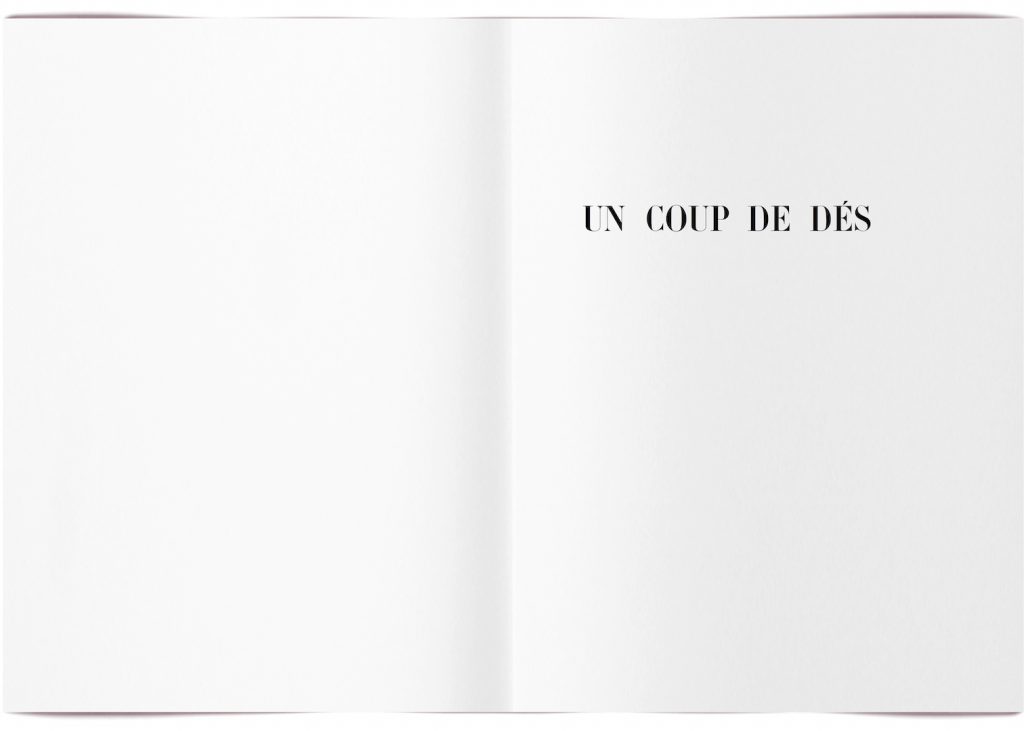
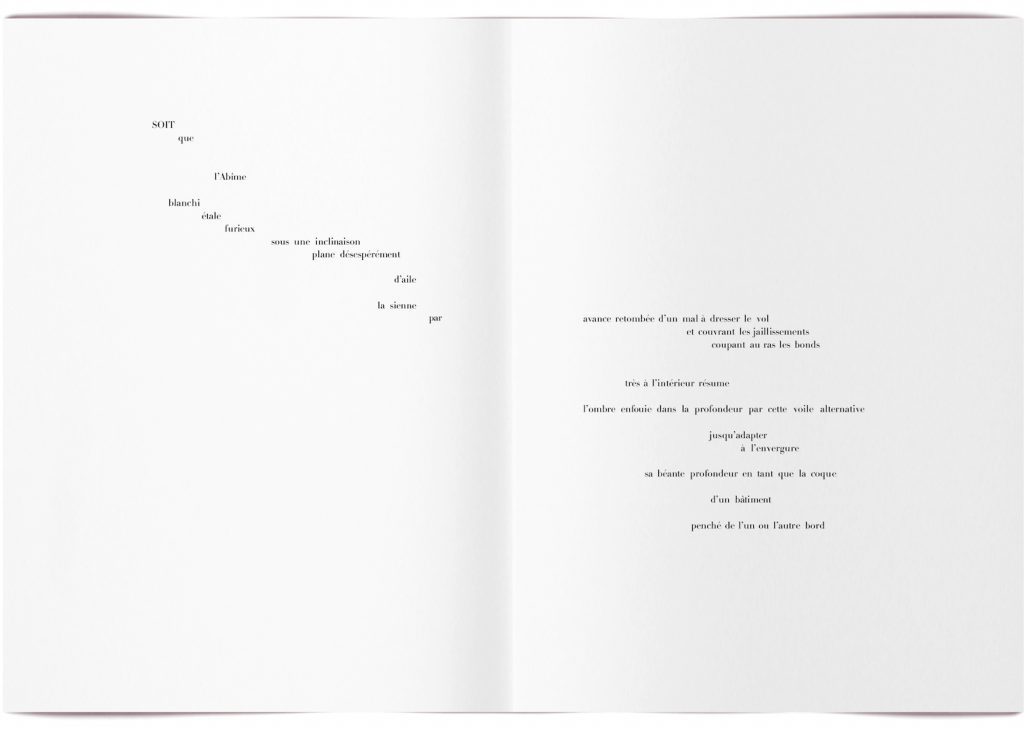
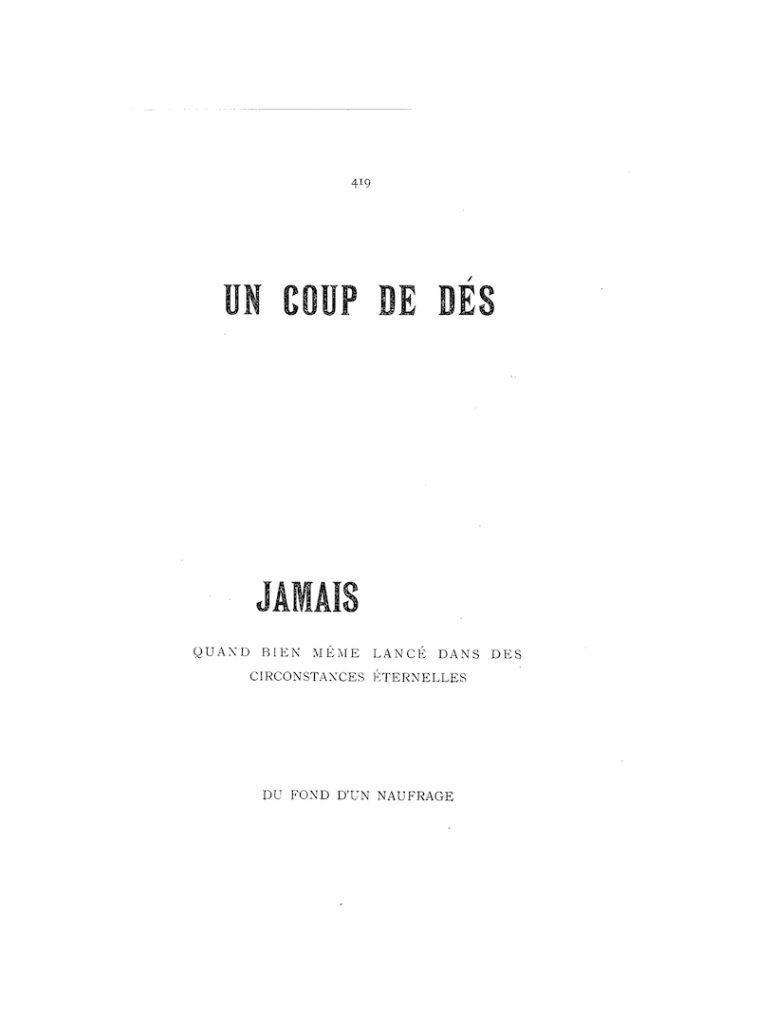
Ein aufgeschlagenes Buch liegt auf einem Tisch.2 Es muss liegen, denn es ist zu groß, um komfortabel in der Hand gehalten und gelesen werden zu können. Die Papierbögen wölben sich im geöffneten Zustand. Vom Falz ausgehend biegen sie sich jeweils konvex nach oben, um dann links und rechts wieder abzufallen. „UN COUP DE DÉS“ – ein Würfelwurf – steht auf der rechten Seite linksbündig geschrieben (Abb. 1). Die linke Seite ist leer. Die vier Wörter stehen groß, fett gedruckt und in Versalien da. Die einzelnen Buchstaben wirken artifiziell. Es treffen fett gezogene Striche, um nicht zu sagen Flächen, auf feine Haarlinien.

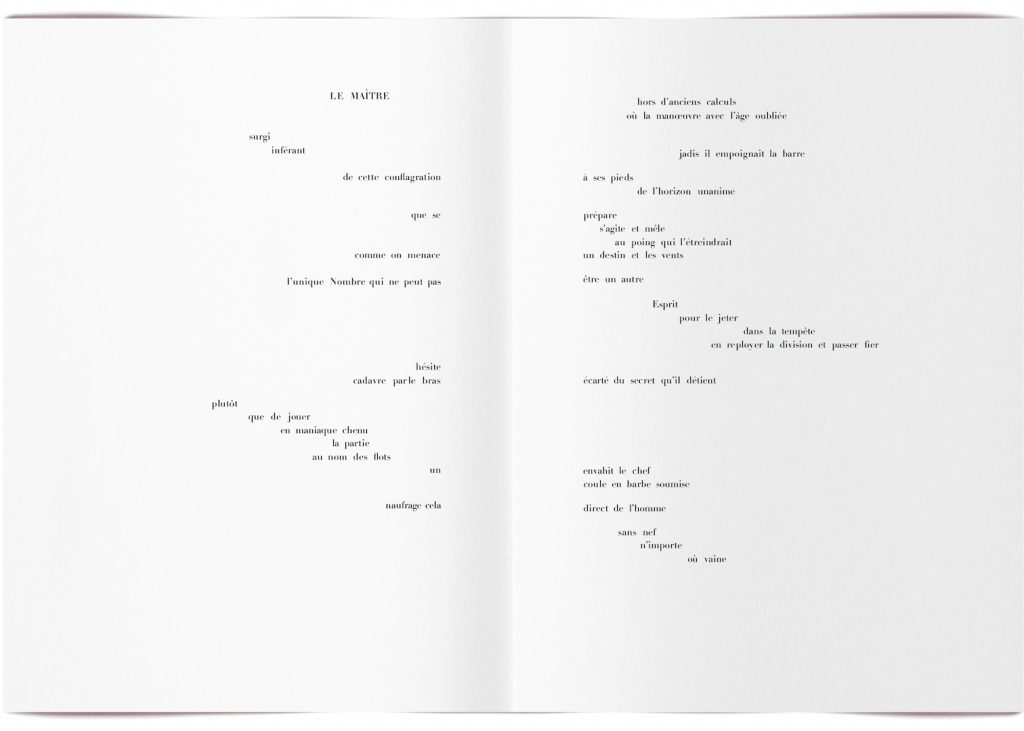
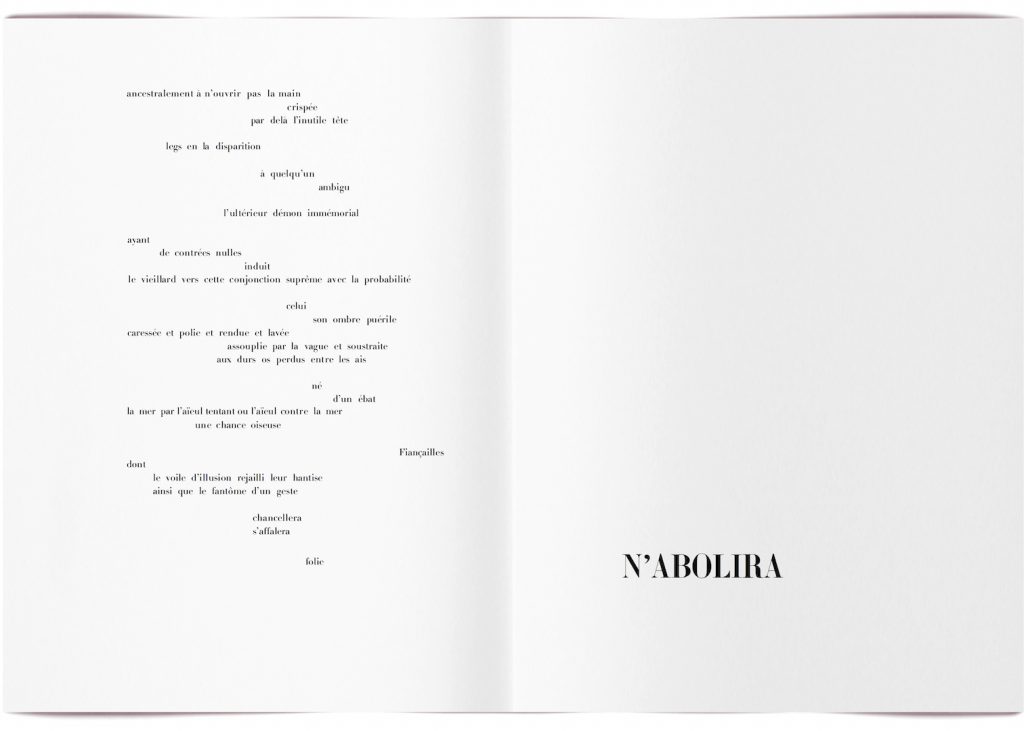
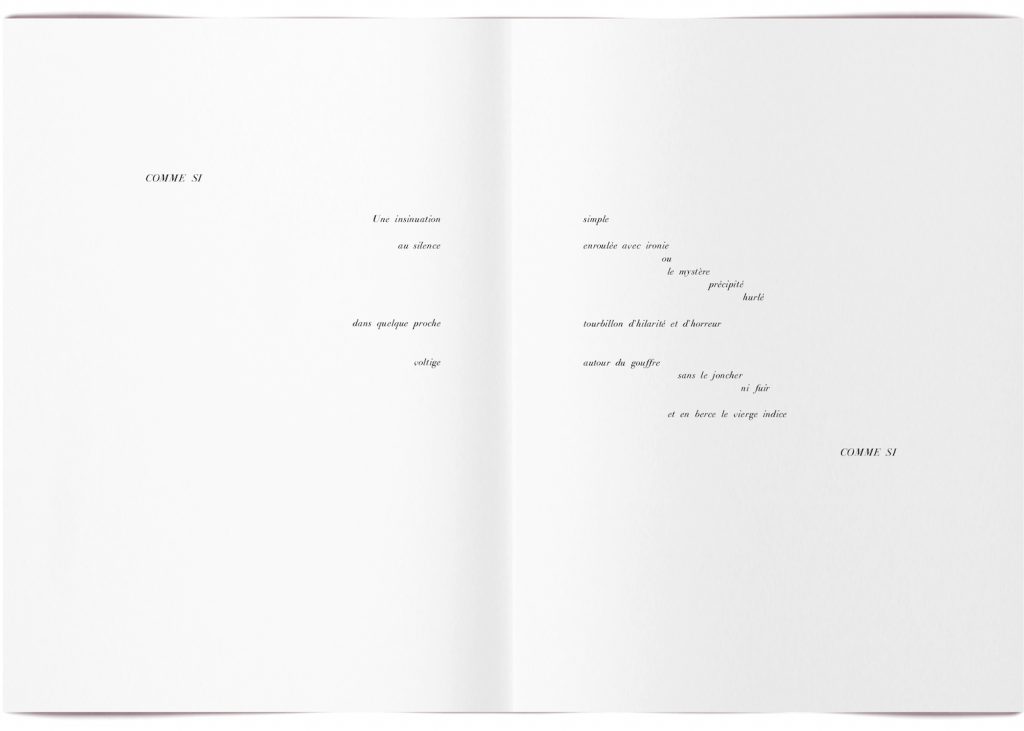
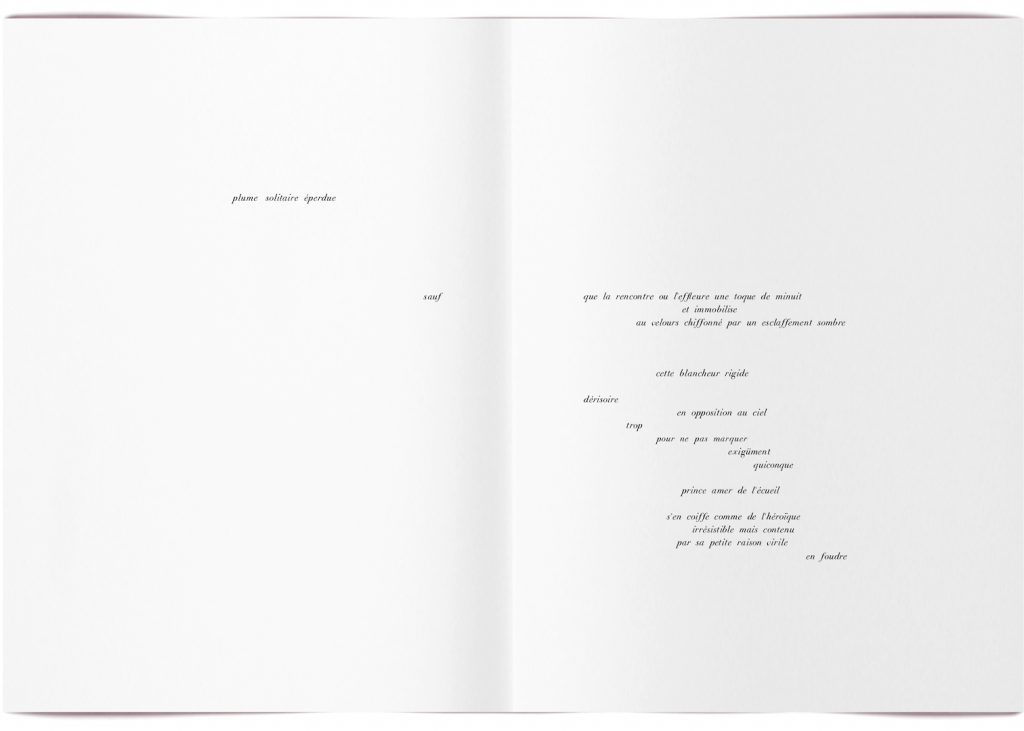
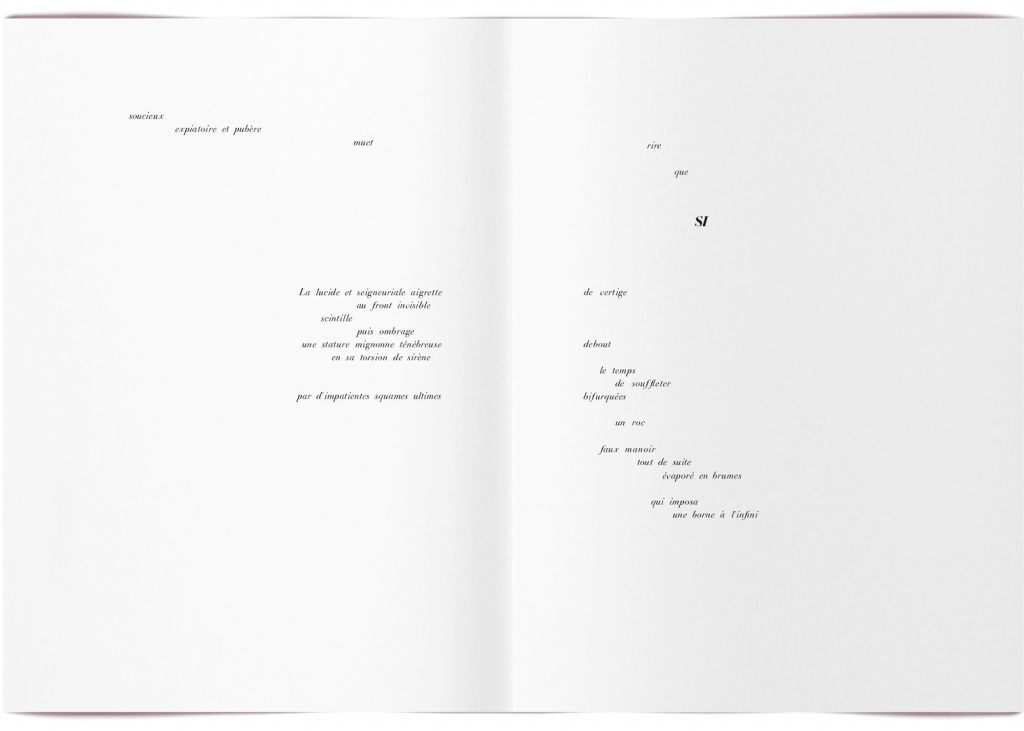
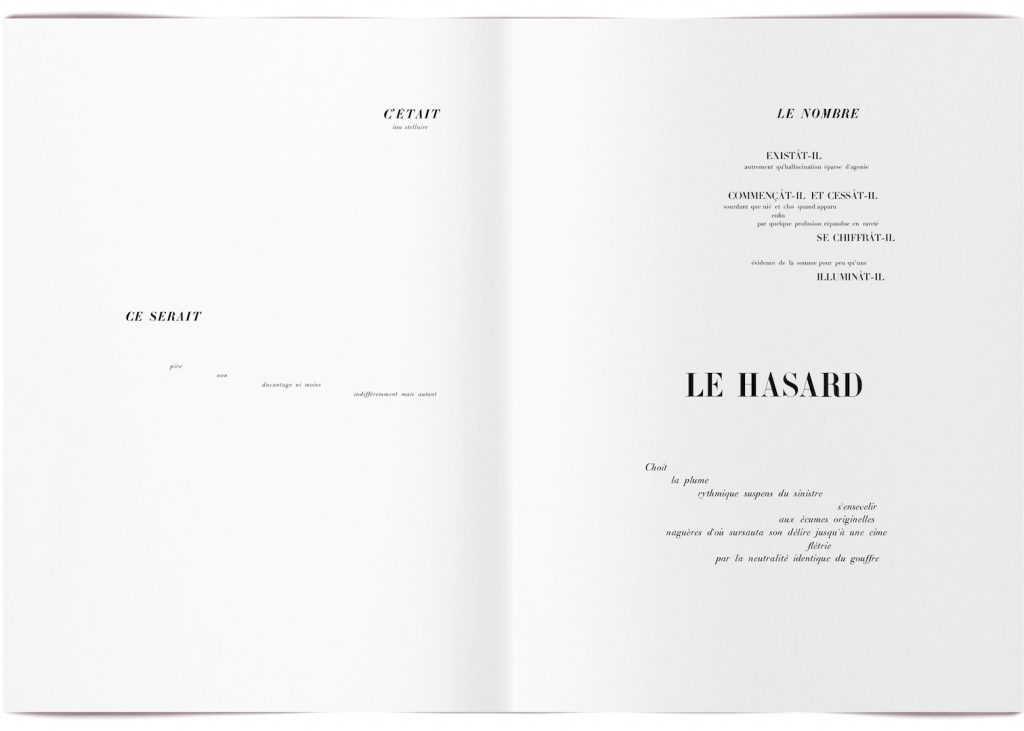
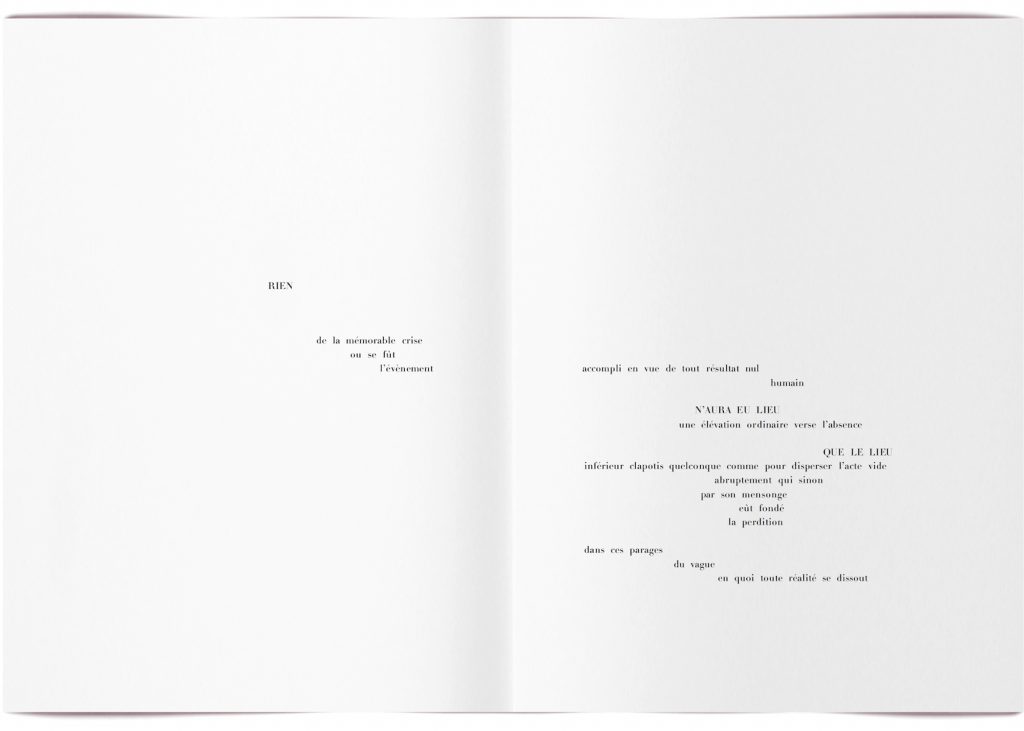
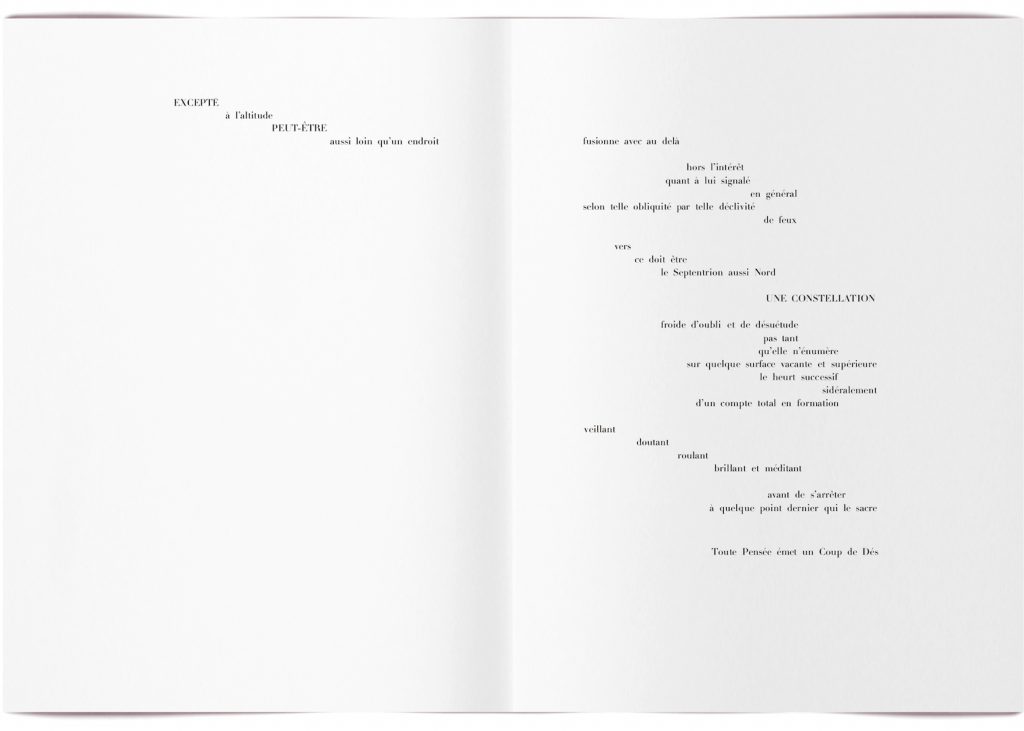
Abb. 1-11: Stéphane Mallarmé, Un coup de Dés jamais n’abolira le Hasard (Rekonstruktion von Michel Pierson & Ptyx), 2004, 38 x 56 cm (Doppelseite).
Quelle: Michel Pierson & Ptyx (Hg.), Stéphane Mallarmé. Un coup de Dés jamais n’abolira le Hasard, Paris/London/Sevilla 2004, URL: http://www.coupdedes.com [19.01.2018].

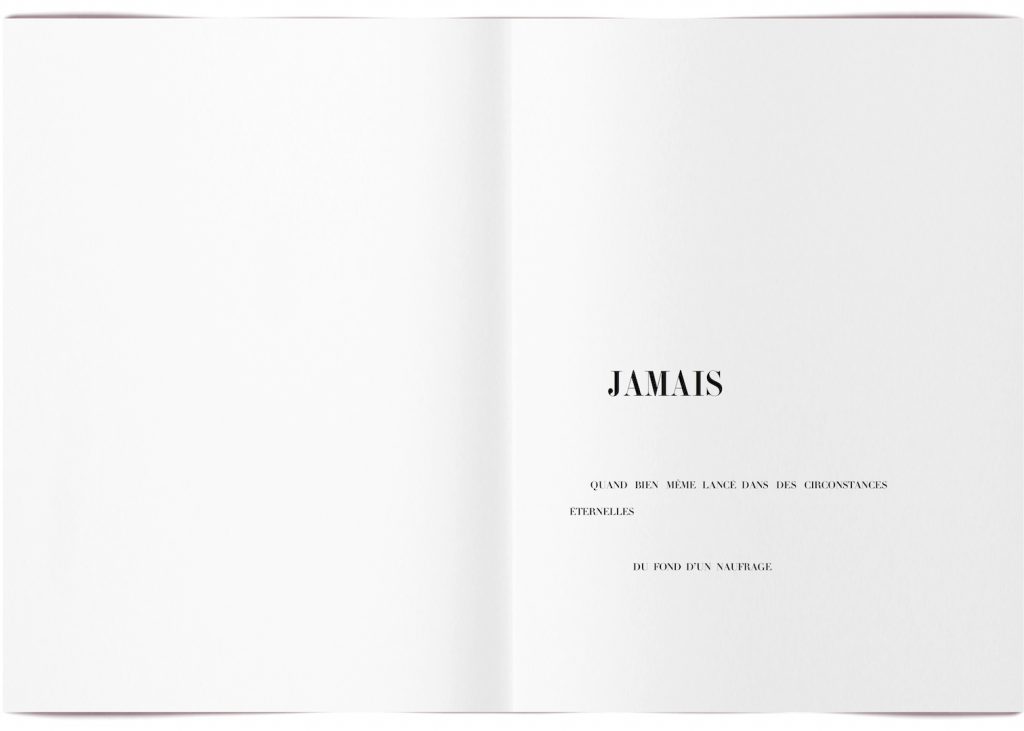
Auf der nächsten Doppelseite tritt einem das Wort „JAMAIS“ in derselben Schriftart, -größe, -stärke und -lage wie „UN COUP DE DÉS“ entgegen (Abb. 2). Die drei unterschiedlich langen Verse darunter sind ebenfalls in Versalien gesetzt, jedoch wesentlich kleiner und in normaler Schriftstärke. Die Anordnung der insgesamt vier Verse ist unregelmäßig. Wieder ist nur die rechte Seite beschrieben und die linke leer.

Auf der nächsten Seite fängt der Text zu fließen an (Abb. 3). Er verläuft von links oben nach rechts unten über die gesamte Doppelseite, wobei er rechts unten dichter wird. An der Stelle von „par“ zu „avance“ wird der Falz unterwandert, die Trennung in eine linke und eine rechte Seite aufgehoben, indem die Zeile sich wie ein Schussfaden in das Gewebe aus Buch und Text einfügt. Auf diese Weise wird die Doppelseite auf formaler Ebene aktiviert.3 Das die Doppelseite einleitende Wort führt die typographische Gestaltung der Seite davor weiter. Es wirkt wie eine Initiale, die in diesem Fall jedoch ein ganzes Wort enthält („SOIT“).4 Danach wechselt der Modus. Art, Größe, Stärke und Lage der Schrift bleiben gleich, doch treten nun Gemeine an die Stelle der Versalien. Der Blick rieselt mit den Wörtern in Richtung Falz. Er lässt sich von der Gestaltung leiten. Nur „l’Abîme“ – der Abgrund – wird durch einen Versal hervorgehoben. Eine Anspielung auf den Falz, den zu überwinden es gilt?

Weitergeblättert wird die „Wort-Initiale“ zitiert: „LE MAÎTRE“ – der Meister – ist in Versalien gesetzt (Abb. 4). Der Rest wird in Gemeinen fortgeführt. Nur in der Mitte der Doppelseite werden zwei Wörter durch jeweils einen großen Anfangsbuchstaben hervorgehoben: „Nombre“ links und „Esprit“ rechts vom Falz. Ein nach beiden Seiten hin stark ausschlagender Flattersatz prägt das Erscheinungsbild der Doppelseite. Hier führt die Syntax zu einer Mannigfaltigkeit: Die Zeilen können „langatmig“ von links nach rechts über den Falz hinweg oder aber „kurzatmig“ von oben nach unten, zuerst linker und dann rechter Seite gelesen werden. Eine Konstante wird evident: der Falz und sein Echo, das er in den vertikalen Achsen links an den Zeilenenden und rechts an den Zeilenanfängen findet. Die Verse scheinen geradezu aus dem Echo herauszukommen und horizontal über das Papier abzufallen. Insgesamt sieben überwinden den Falz. Als Horizontalen, die wie Fäden wirken, verbinden sie die linke und rechte Seite optisch miteinander.

Auf der nächsten Seite zieht das laute „N’ABOLIRA“ die gesamte Aufmerksamkeit auf sich und den Blick zunächst nach rechts unten (Abb. 5). Typographisch greift die Phrase die Gestalt der einleitenden Wörter „UN COUP DE DÉS“ und „JAMAIS“ auf. Die Schrift ist groß und fett gedruckt und in Versalien gesetzt. Den leeren Raum darüber kompensieren die vielen ungleich langen Verse auf der gegenüberliegenden Seite. Eine merkwürdige Stabilität bildet sich ab, die diesmal aber nur bedingt etwas mit dem Falz zu tun hat: Die vertikale Achse ist von innen nach außen verrutscht, von der Mitte an den Rand. Sechs Verse setzen auf gleicher Höhe ein. Das Lesen der Seite ist aufgrund der unterschiedlichen Einschübe ein sprunghaftes. Ein kurzer Vers folgt auf einen langen, ein langer auf einen kurzen und so weiter. Nur ein Wort tanzt aus der Reihe: „Fiançailles“ – Verlobung. Es fängt mit einem Versal an und grenzt sich zusätzlich räumlich vom restlichen Versgefüge ab. Stärker integriert in das Gefüge, sich aber ansatzweise lösend steht „folie“ unten, leicht versetzt. Der letzte Vers der linken Seite. Würde die Grundlinie des Wortes auf die rechte Seite durchgezogen, stieße sie im oberen Viertel auf die gegenüberliegenden Buchstaben des „N’ABOLIRA“. Der Wahnsinn trifft auf das „Nicht-auslöschen-wird“, streicht es gewissermaßen durch. Die Negation auf inhaltlicher Ebene wird performativ auf der syntaktischen wiederholt. Mit Jacques Derrida lassen sich die Verlobung und das Nicht-auslöschen-wird außerdem auf das Weiß der sonst leeren Seite beziehen beziehungsweise das Weiß auf die Wörter: Sogar die Verlobung, die den Vollzug der Ehe ankündigt, wird die Jungfräulichkeit des weißen Papiers nicht aufheben können.5 Das Hymen als Derridasche Figur der Unentscheidbarkeit bleibt – auch nach dem Hinterlassen einer (weißen!) Spur, dem Auftragen schwarzer Tinte – intakt; wie das Weiß der Seite erfüllt es seine Funktion nur in Bezug auf die Markierung/Penetration.

Mit dem Wenden der Seite verändert sich die Lage der Schrift (Abb. 6). Der Text neigt sich, kursiv gesetzt, nach rechts. „COMME SI“ – als ob – erscheint, den Text ein- und wieder ausleitend, gleich zweimal. Auf die Löschung folgt die Verdoppelung. Das Wort-Paar klammert den restlichen Text ein und scheint imaginär die Wörter durch eine gegengleiche Bewegung, die nach links oben beziehungsweise rechts unten führt, aus dem Falz zu ziehen. Dabei wird das Phänomen der „Wort-Initiale“ einmal mehr aufgegriffen. Das „Textinnere“, eingeklammert durch zweimal „COMME SI“, beginnt mit einem Versal: „Une insinuation“ – Eine Andeutung. Durch den Versal wird, zusätzlich zur Kursivlage der Schrift, der Einsatz eines zweiten Themas im Gedicht betont. Auf inhaltlicher Ebene ersetzt ein Prinz, der auf der nächsten Doppelseite genannt wird, den bisherigen Protagonisten, den Meister. Jene Verse, die den Falz kreuzen, wahren weiterhin den konstant bleibenden Abstand zur Mitte.

Blättert man zur nächsten Seite, wird die kursive Schriftlage beibehalten (Abb. 7). Der Text fließt in Gemeinen weiter. Links oben „schwebt“ ein dreiteiliger Vers über der weißen Weite des Papiers („plume solitaire éperdue6). Erst ein wenig weiter unten, an die vertikale Achse anstoßend, erscheint ein weiteres Wort („sauf“ – außer). Es ist über den Falz hinweg auf einer Linie mit „que la rencontre ou l’effleure une toque de minuit7. Es folgen mal längere, mal kürzere Verse. Das Schriftbild verdichtet sich nach rechts unten.

Der Text bleibt kursiv (Abb. 8). Der Falz wird sogleich überquert („muet rire“ – stummes Lachen). Dann setzt erstmals eine Art Rückwärtsbewegung ein. Sie führt hinunter zum aufleuchtenden „SI“, das größer, fett und in Versalien gesetzt ist. Es ist unklar, ob es ein Ende, einen Anfang oder eine betonte Pause markiert. „La lucide et seigneuriale aigrette de vertige8. Das großgeschriebene L impliziert, zumindest orthographisch, einen Satzanfang. Die drei Verse, die über den Falz verlaufen, bilden eine Naht, ehe die übrigen in die rechte untere Ecke rieseln. In Form eines großen, kursiven R schreibt sich der Text in die Doppelseite ein.

Mit dem Umblättern ist der Höhepunkt der Komposition erreicht (Abb. 9). Schwarz auf Weiß leuchten die fett gedruckten Wörter unterschiedlich stark auf. „C’ÉTAIT“, „LE NOMBRE“ und „CE SERAIT“ greifen sie das Erscheinungsbild der „SI“ der vorhergehenden Seite auf. Darunter befinden sich jeweils kursiv gesetzte Gemeine, die jedoch kleiner als bisher auftreten. Sie scheinen zu flüstern. Auf der rechten Seite erscheint ab „LE NOMBRE“ ein Konglomerat aus Versalien im Sinn der „Wort-Initialen“ und den kleinen Gemeinen. Fünfmal blitzt dieselbe Endung, „-ÂT-IL“, wie ein Echo hervor. „LE HASARD“ ist dezent mit dem letzten Vers der linken Seite („indifférement mais autant9) verwoben, indem sie sich eine Grundlinie teilen. Auffälliger ist dagegen der Zusammenhang mit den gleich gestalteten Versen „UN COUP DE DÉS“, „JAMAIS“, „N’ABOLIRA“. Der Text läuft mit „Choit“ – Fällt – kursiv weiter. Und wieder ist der Anfangsbuchstabe ein Versal. Zum dritten Mal im Seitenthema. Typographisch weist diese neunte Doppelseite die bisher größte Vielfalt auf. Sechs verschiedene Schriftvarianten sind auszumachen.

Das „RIEN“ der nächsten Seite lässt einmal mehr die „Wort-Initiale“ zum Zug kommen (Abb. 10). Gleichzeitig steht es visuell eng in Verbindung mit den Versen „N’AURA EU LIEU“ und „QUE LE LIEU“, die in den weiteren Textverlauf verwoben sind und gemeinsam einen Satz bilden.10 Der Rest besteht aus Gemeinen. Das Seitenthema scheint verlassen, da die Kursivierung aufgehoben ist. Ein Vers überbrückt den Falz unter Wahrung des konstatierten Abstands („l’évènement accompli en vue de tout résultat nul“11). Die restlichen Wörter fließen, wie nun schon gewohnt, nach rechts unten.

Ein letztes Mal umgeblättert schließen die Verse „EXCEPTÉ“, „PEUT-ÊTRE“ und „UNE CONSTELLATION“ visuell an die vorangegangenen „RIEN“, „N’AURA EU LIEU“ und „QUE LE LIEU“ an (Abb. 11). Wieder bleibt der Rest in Gemeinen. Und wieder verläuft ein Vers, relativ weit oben, über den Falz. Während die linke Seite – abgesehen von der Treppe, die zur Mitte führt – vor allem das Weiß des Papiers prägt, ist die rechte von einem dichten Versgefüge durchzogen. Ein paar Versalien haben sich darin eingeschlichen. Die Verse „le Septentrion aussi Nord“12 und „Toute Pensée émet un Coup de Dés“13 weisen insgesamt sechs Versalien auf – so viele wie der Würfel Seiten hat.

Beim Zurückblättern fällt auf, dass vier der Doppelseiten strukturell gleich gestaltet sind: die den Fließtext einführende dritte, die siebente, die zehnte und die das Buch abschließende elfte. Ihre Gemeinsamkeit liegt im Verhältnis des Textverlaufs zum Weiß und zum Falz. Sie alle führen eine Bewegung durch von links oben nach rechts unten. An jeweils einer Stelle wird der Falz mit einem Vers überwunden. In Richtung rechte untere Ecke verdichtet sich der Text. Im gesamten Gedicht wird vollständig auf die Verwendung von Satzzeichen verzichtet. Manchmal tauchen sie geisterhaft zum Beispiel in Form einer Verdoppelung („COMME SI“-Klammer) oder ausgeschrieben („à quelque point dernier qui le sacre“14) auf. Auch die Zahl ist getilgt. Das Buch ist nicht paginiert. Lediglich als Wort bleibt die Zahl erhalten. Mit „Nombre“ wird sie auf der vierten Doppelseite explizit genannt. Am Ende des Gedichts wird sie noch einmal, auf ganz andere Art, impliziert: im Siebengestirn. Die Zahl in den Sternen wird auf die weißen Seiten eines geöffneten Buches projiziert, indem sie im Schriftbild in Form des Großen Wagen erscheint. Das Gedicht beginnt mit „UN COUP DE DÉS“. Und es endet mit „Toute Pensée émet un Coup de Dés“. Das Ende führt an den Anfang zurück.

II.

Paris, im Mai 1897. Ein Spaziergang auf den Champs-Élysées. An einer Straßenecke, ein Zeitungsstand. Beim Griff in die Hosentasche scheppern die Münzen. Für 3 Francs 25 kann man hier die 17. Ausgabe der Zeitschrift Cosmopolis erwerben. Eine Zeitschrift, in der Beiträge in französischer, englischer und deutscher Sprache veröffentlicht werden. Die Ausgabe enthält unter anderem ein Gedicht von Stéphane Mallarmé: Un coup de Dés jamais n’abolira le Hasard.15 Es verblüfft durch seine Form. Daher ist dem Gedicht ein einführendes Vorwort beigefügt. Doch Mallarmé ist nicht zufrieden mit dieser erstpublizierten Fassung (Abb. 12). Die typographische Gestaltung entspricht noch nicht seinen Vorstellungen und auch das Vorwort sollte eigentlich entfallen. Er beginnt zu korrigieren. Bereits ein halbes Jahr zuvor hat ihm der französische Galerist und Verleger Ambroise Vollard vorgeschlagen, eine „Luxusausgabe“ des Gedichts herauszugeben. Sie sollte wesentlich größer ausfallen als der herkömmliche Gedichtband. Man entscheidet sich für das Folio-Format. Ein Format, bei dem die Papierbögen jeweils nur einmal gefaltet werden. Eine Seite entspricht in etwa der Größe eines A3-Blattes. Das heißt: viel leerer Raum. Ein Aspekt, der Mallarmé besonders wichtig erscheint, im kommerziellen Buchdruck allerdings selten auftaucht. Schließlich soll so wenig Papier wie möglich „verschwendet“ werden. Bei der Frage nach der Schrifttype fällt die Wahl auf die Didot. Eine klassizistische Antiqua, die sich durch stark voneinander abweichende Strichstärken auszeichnet. Satte Flächen treffen auf feine Linien. Weitere Schriften kommen nicht zum Einsatz. Dafür: Variationen der Didot. Zahlreiche Andrucke werden angefertigt, die Mallarmé unermüdlich überarbeitet. Neunzehn korrigierte Exemplare existieren noch. Zur Veröffentlichung einer finalen Ausgabe wird es aber nicht mehr kommen. 1898, gut ein Jahr nach der Erstveröffentlichung, stirbt Mallarmé unerwartet. Un Coup de Dés bleibt ohne Ende. Eine autorisierte, letzte Version existiert nicht.

Abb. 12: Stéphane Mallarmé, Un Coup de Dés jamais n’abolira le Hasard (Beispielseite), 1897, 21 x 14,85 cm (Einzelseite).
Quelle: Cosmopolis, 17, 1897, S. 425.

Und trotzdem muss das Erscheinungsbild in eine Analyse miteinbezogen werden, will man das Gedicht auch nur ansatzweise erfassen, handelt es sich doch um eine sehr spezielle Art der Notation. Verse, die teilweise nur noch aus einzelnen Wörtern bestehen, sind mehr oder weniger lose, das heißt isoliert, auf dem Weiß des Papiers verteilt. Zusätzlich sind sie durch sich verändernde Schriftgrößen und -stärken unterschiedlich stark betont. Auch wurde neben dem Hauptthema, das in normaler Schriftlage gesetzt ist, ein „kursives“ Seitenthema erkannt. Die Nähe zur Musik ist evident. Und tatsächlich zieht Mallarmé im Vorwort der Erstausgabe die Partitur als Vergleich heran. Die Variationen im Bereich der Typographie sind insofern als Hinweise für die Intonation sowie für die Lautstärke und Klangfarbe zu verstehen.16 Drei Jahre zuvor hebt er in einem Vortrag hervor, dass Musik und Literatur dieselbe Sprache sprechen – die sich nicht zuletzt in der einander überlappenden Terminologie äußert –, weil beide aus einer Quelle entspringen.17 Das Metrum existiert in der Musik und es existiert in der Poesie. Es könnte auch Takt geheißen werden. Da wie dort zeigt die Metrik den Rhythmus an.

Das genau komponierte „Rieseln“ der Wörter von links oben nach rechts unten, das einem die Lesebewegung vor Augen führt. Die Betonung einzelner Wörter durch die variierende Typographie und die damit einhergehende Akzentsetzung im Fließtext. Momente, die dem Coup de Dés seine Rhythmik verleihen. Mallarmé notiert nicht so sehr eine Form als vielmehr eine Bewegung. Nicht zuletzt eine Schreibbewegung. Sprache wird dabei ins Räumliche übersetzt. Und so meint Jacques Rancière in dem Gedicht einen Akt der Verräumlichung zu erkennen, durch den die Bewegungen des Geistes – das Zusammenfalten und Entfalten, das Zusammenziehen und Ausdehnen – ans Licht treten. Diese ahmen den Rhythmus von Nacht und Tag – Rancière nennt sie „den täglichen Tod und die tägliche Wiederauferstehung der Sonne“ – nach.18 „Rhythmus“ ist in diesem Sinne stark an etwas Zeitliches, vielleicht sogar Periodisches, das heißt regelmäßig Wiederkehrendes, gebunden – an dieser Stelle ist wiederum an den Takt zu erinnern.

„Rhythmus“ leitet sich etymologisch vom griechischen Wort für Form ab, wie Émile Benveniste aufgezeigt hat.19 Darunter ist jedoch keine starre Form zu verstehen, sondern die Formwerdung, das Fließen in die Form. Ursprünglich meint Rhythmós „die Form in dem Augenblick, in dem sie angenommen wird durch das, was beweglich, bewegend, flüssig ist, die Form von dem, was keine organische Konsistenz besitzt“20 – eine Form also, in der das Regelmäßige kategorisch ausgeschlossen ist. Die Verwendung des Wortes veränderte sich im Laufe der Zeit aber, ist gewissermaßen „verflossen“. Der Begriff der flüssigen, noch formlosen Form wird nach und nach mit Begriffen der Dauer gesättigt, durch die Wiederholung strukturiert. Die autonome, das heißt freie, Bewegung der Form wird in gleichmäßige Intervalle zerlegt. „Unser“ Rhythmus ist geboren. Seit Platon ist der Rhythmus an das Maß gebunden, womit die Zahl als Ordnungsinstanz ins Spiel kommt. Das Wort beschreibt von nun an ein Phänomen, das kontinuierlich durch das Metrum gegliedert ist. Indem Mallarmé den „getakteten“ Rhythmus in seine „Formlosigkeit“ rückübersetzt, der dadurch seine Beweglichkeit wiedererlangt, hebt er diesen Schritt auf. Un Coup de Dés ist als eine Form zu begreifen, die sich nicht festlegt. Eine Form, die beweglich bleibt und sich im Schweigen der Buchseiten ausbreitet.

Mallarmé gelangt nun zu dieser Form, indem er den Vers – in dem Fall den Alexandriner – zerbricht, da er schal geworden ist. Von Victor Hugo auf seinen Höhepunkt gebracht, ist von ihm nicht mehr als eine leere Worthülse („vieux moule fatigué“) übriggeblieben.21 Doch gerade das Wort – und nicht seine Hülse – scheint Mallarmé zu interessieren. Nicht umsonst akzentuiert er es auf spezifische Art und Weise im Coup de Dés. Mit dem Freistellen der Wörter und dem Verzicht auf Interpunktion geht ihre Aufwertung einher, da sie derartig anfangen, in mannigfaltige Beziehungen zu treten und mithin mehrdeutig zu werden. Die weiße Fläche wird ihnen zum Handlungsspielraum. Fügt man die Verse „UN COUP DE DÉS / JAMAIS / N’ABOLIRA / LE HASARD“22 zusammen, erhält man einen klassischen Alexandriner mit weiblicher Kadenz (13 Silben). Die Zäsur würde sich zwischen „JAMAIS“ und „N’ABOLIRA“ befinden, wäre sie nicht woanders hin gewandert. Das Ungewöhnliche an diesem Vers ist nun aber, dass er über das gesamte Buch verteilt ist. Sein Zusammenhang ergibt sich aus der typographischen Gestaltung, indem er die größten Lettern aufweist, fett und in Versalien gesetzt ist. Ähnlich verhält es sich mit den Versen „SI / C’ÉTAIT / LE NOMBRE / CE SERAIT / LE HASARD“23 und „RIEN / N’AURA EU LIEU / QUE LE LIEU / EXCEPTÉ / PEUT-ÊTRE / UNE CONSTELLATION“24.

Der Alexandriner ist also nur insofern anwesend, als er gerade dabei ist zu zerfallen. Nach Hans-Jost Frey kann der Verszerfall in drei Stufen verlaufen, wobei er bei Mallarmé zwei davon verwirklicht sieht: Auf der ersten Stufe entfällt die Zäsur. Die zwölf Silben verlieren ihre Maßeinheit, ihren regelmäßigen Takt, und werden dadurch frei kombinierbar. Die Brücke, die sie verbindet wie trennt, kann nicht mehr beobachtet werden. Die zweite Stufe betrifft die Silben selbst. Sie werden um eine verlängert oder brechen frühzeitig, schon nach der elften, ab. Der Vers und sein Maß bleiben als Andeutung oder Erinnerung jedoch erhalten. Als die Instanz, von der abgewichen wird. Mit der letzten Stufe wäre der freie Vers erreicht, in dem der alte völlig verschwunden ist.25 Weil die Zäsuren im Coup de Dés nun über die Seiten in den Falz hinein gerutscht sind – wohin wären sie sonst verschwunden? –, fängt der Vers an wieder beweglich zu werden und sich über die Buchseiten zu verteilen. Die Lektüre stellt sich als ein Spiel heraus, bei dem er wiedergefunden werden soll. Sie ist Verssuche. Man blättert vor und zurück, zählt die Silben und sucht die Zäsur. Doch sobald man den Vers zu haben meint, ist er auch schon wieder entwischt. Stets gleitet er einem durch die Finger. Denn der Vers ist nur in bereits aufgelöster Form da. Als etwas Negiertes. Er ist zu erahnen, nicht aber zu fassen.

Etwas Unfassbares – im Sinne von Nichtgreifbaren – scheint Mallarmé auch darstellen zu wollen. Im Vorwort zur Cosmopolis-Ausgabe spricht er von prismatischen Aufteilungen der Idee („subdivisions prismatiques de l’Idee“).26 Sofort fühlt man sich an die Zersplitterung und Verteilung des Verses erinnert. Indem das, was aufgeteilt wird, Idee heißt, scheint es einen engen Zusammenhang zu geben zwischen dem Vers, der Idee und ihrer Darstellung. Dass die Aufteilungen schließlich „prismatisch“ verlaufen, verweist auf zweierlei: Einerseits, dass es sich um einen Zerlegungsprozess handelt und andererseits, dass diese Zerlegung auf einen Reinzustand – wie zum Beispiel die Spektralfarben in einem sind – zurückführen soll. Da die Idee aber eben nicht unmittelbar erfasst und demnach auch nicht dargestellt werden kann, weil Mallarmé sie als etwas im Wort oder im Begriff Abwesendes denkt,27 kann man nur versuchen sie zu reflektieren. Und genau das scheint Mallarmé im Coup de Dés mittels seiner Notation zu tun.

Gérard Genette hat darauf hingewiesen, dass der Vers im Mallarméschen Sprachgebrauch im Wesentlichen mit dem Wort zusammenfällt. Im Isolieren einzelner Wörter aus ihrer Syntax drückt sich der große Wert aus, den Mallarmé ihnen beimisst.28 Seine Poesie ist der Versuch das Wort der Alltagssprache zu entheben, die – abgesehen von wenigen onomatopoetischen Ausdrücken – ganz und gar arbiträr ist. Sinn und Klang sind nicht aufgrund von Ähnlichkeit, sondern Konvention miteinander verbunden. In dem Aufsatz Crise de vers beklagt Mallarmé, dass im Französischen das dunkle „jour“ den hellen Tag sowie das helle „nuit“ die dunkle Nacht beschreiben muss.29 Ihre Zuschreibung ist eine rein zufällige oder „falsche“. Mallarmé scheint ihre Entsprechung herbeizusehnen. An der Stelle fängt der Vers zu wirken an und das Wort seine schöpferische Kraft zu entfalten. Denn seine „souveräne Geste“, wie Genette sich ausdrückt, leugnet die Arbitrarität des Zeichens, ohne dass diese rückgängig gemacht wird.30 Der von einer Sprachgemeinschaft festgelegte Sinn wird nicht ausgelöscht (und kann auch nicht ohne weiteres ausgelöscht werden). Der Vers dient nicht der Korrektur. Mallarmé sagt nicht plötzlich „jour“ zur Nacht. Vielmehr soll dieser „Mangel der Sprache“, das heißt ihre Zufälligkeit, kompensiert werden.31 Die Verbindung zwischen Sinn und Klang wird gelockert, bleibt aber – wenn auch leiser geworden – erhalten. Auf diese Weise entsteht eine gewisse Spannung zwischen den Inhalten, der Klangqualität und dem nun mehrfach besetzten Wort – die für die Poesie allgemein von höchster Bedeutung ist. Es wird dem Wort ein Spielraum geboten, in dem es ungeahnte, vielleicht „richtigere“, Verbindungen eingehen kann und dadurch neue Assoziationsfelder eröffnen.

Im Coup de Dés erweist sich das Weiß des Papiers als ein solcher Spielraum. Neben den Alexandrinern – sie sozusagen begleitend – entstehen Gleichklänge wie das „-ÂT-IL“-Echo oder die Treppe, die auf der letzten Doppelseite durch „veillant“, „doutant“, „roulant“, „brillant et méditant“ gebildet wird und ihre tonale Abstufung über „den vakanten Raum“32 visuell evoziert. Aber nicht einmal ein Würfelwurf – warum auch gerade der? – kann den Zufall aufheben. Höchstens es gelingt einem, die unwürfelbare Zahl, die Sieben, zu erzielen. Und tatsächlich versteckt sie sich, als Sternbild verkleidet, auf der letzten Seite („le Septentrion aussi Nord“). Der große Versuch das Unmögliche für einen Moment möglich zu machen, Genettes „souveräne Geste“ sich vollziehen zu lassen. Mallarmé zerbricht den Vers und rhythmisiert im selben Schritt das Schriftbild, um das Andere der Sprache – das, was sie nicht bedeutet, wonach sie aber klingt – zum Vorschein zu bringen. Die Zwischenräume werden zu Orten (oder viel eher Nicht-Orten) der Reflexion. In ihnen kann sich die Idee abzeichnen, um da und dort – je nach Lichteinfall, möchte man fast sagen – kurz aufzuleuchten. Ihre Darstellung geschieht nicht durch den Vers – denn das wäre seine Instrumentalisierung –, sondern in ihm, in jenem Zerbrechen, das die Möglichkeit enthält des Anderen, ebenso facettiert hervorzuschimmern.

Rancières Vorschlag, es handle sich um die Darstellung von Denkbewegungen, erscheint plausibel, sofern diese Bewegungen nicht als etwas Regelmäßiges aufgefasst werden. Und vielleicht stellt sich in ihnen die Idee dar, von der Mallarmé immer wieder spricht und die er mit Hilfe der Metapher der Blume und ihren Sträußen als etwas Fehlendes denkt.33 In ihrer ganzen Komplexität nicht darstellbar, kann sie nur „prismatisch“ zerlegt, mit anderen Worten zersplittert, sichtbar gemacht werden. Die Splitter schreiben sich in die Buchseiten ein als Verse eines gleichsam übergeordneten Verses der Idee – der Konstellation. Das, was fehlt, das Gesuchte, findet in den Zwischenräumen statt: in der schweigenden Leere des Papiers oder, indirekt, im Falz, in dem die Zäsuren gebündelt sind. Mit dem Auffinden und gedanklichen Zusammensetzen des Verses ist das kurze Aufblitzen der Idee verbunden, die sich zwar permanent entzieht und letztlich also unfassbar bleibt, ihren Entzug aber, auf indirektem Wege, immerhin darzustellen vermag.


1 Für zahlreiche Anregungen danke ich herzlich Wolfram Pichler und Gregor Pirgie.

2 Es handelt sich hier und im Folgenden um die Rekonstruktion des Coup de Dés von Michel Pierson & Ptyx aus dem Jahr 2004, die auf den erhaltenen Andrucken und Korrekturen Mallarmés basiert. Zwei Andrucke befinden sich in der Bibliothèque nationale de France und sind über Gallica zugänglich.

3 Die Doppelseite fällt hier – sowie bei etwa der Hälfte der folgenden Doppelseiten – mit der klassischen Lesart von linker und rechter Seite zusammen. Auf jenen Seiten, in denen mehrere Zeilen den Falz unterwandern, ist das Schriftbild und mit ihm der Schriftverlauf zwar enger an die Doppelseite gebunden, die klassische Lektüre jedoch keineswegs ausgeschlossen, sondern vielmehr Teil des multivalenten Beziehungsgeflechts, das sich im Coup de Dés entfaltet.

4 Der Begriff der Initiale wird hier auf das Phänomen der Hervorhebung eines oder zweier Wörter, die die jeweilige Seite einleiten, übertragen. Im Folgenden wird von der „Wort-Initiale“ die Rede sein.

5 Derrida spricht vom „jungfräulichen Papier“, das sogar der Akt der Einschreibung nicht zu beflecken vermag, ohne dabei aber die Jungfräulichkeit mit der Verlobung oder dem Nicht-auslöschen-wird in Verbindung zu bringen. Jacques Derrida, Dissemination, hg. von Peter Engelmann, Wien 1995, S. 249.

6 „Einsame, bestürzte/leidenschaftliche Feder“. Übertragungen ins Deutsche von der Autorin. Ich danke Cedric Huss und Céline Juyou für das Korrekturlesen.

7 „Sie trifft oder berührt flüchtig/streift eine Mitternachtsmütze“.

8 „Der helle und herrschaftliche Federschmuck des Schwindels“.

9 „Gleichgültig aber so (viel)“.

10 Für den Satz und dessen Übersetzung siehe Fußnote 24.

11 „Das Ereignis erfüllte im Hinblick auf das Resultat nichts“.

12 „Das Siebengestirn des Großen Wagen“.

13 „Jeder Gedanke ergibt einen Würfelwurf“.

14 „Am letzten Punkt, der ihn heiligt“.

15 Die Editionsgeschichte des Gedichts ist eine äußerst komplizierte. Diesbezüglich sei vor allem auf die Ausführungen von Thierry Roger, L’archive du Coup de dés. Étude critique de la réception d’Un coup de dés jamais n’abolira le hasard de Stéphane Mallarmé, Paris 2010, S. 1035 – 1037 verwiesen.

16 Vgl. Stephane Mallarmé, Vorwort zum Coup de Dés, in: Cosmopolis, 17, 1897, S. 418.

17 „Alsdann besitzt man gerade eben die wechselseitigen Mittel des MYSTERIUMS – vergessen wir die alte Unterscheidung, zwischen MUSIK und LITERAE, sie ist nur die gewollte Trennung, um ihn dereinst wiederzufinden, des ursprünglichen Zustands: die eine hierbei Beschwörerin von Zaubern, die an dem abstrakten Punkte des Hörens und beinahe Sehens angesiedelt sind, aus dem Verstehen wurde; das, verräumlicht, dem bedruckten Blatt gleiche Tragweite zugesteht.“ (Stéphane Mallarmé, La Musique et les Lettres, in: ders., Kritische Schriften, Bd. 2, hg. von Gerhard Goebel/Bettina Rommel, Gerlingen 1998a, S. 92 – 127, S. 107). Musik und Literatur bilden „zweimal vollendet sich oszillierend eine einzige, ganze Gattung.“ (Mallarmé 1998a, S. 109).

18 Jacques Rancière, Der Raum der Wörter. Von Mallarmé zu Broodthaers, in: Sabine Folie (Hg.), Un Coup de dès. Bild gewordene Schrift. Ein ABC der nachdenklichen Sprache (Kat., Generali Foundation), Wien/Köln 2008, S. 26 – 38, S. 30.

19 Vgl. Émile Benveniste, Der Begriff des „Rhythmus“ und sein sprachlicher Ausdruck, in: ders., Probleme der allgemeinen Sprachwissenschaft, München 1974, S. 363 – 374.

20 Benveniste 1974, S. 370 – 371.

21 Stéphane Mallarmé, Crise de vers, in: ders., Kritische Schriften, 2, hg. von Gerhard Goebel/Bettina Rommel, Gerlingen 1998b, S. 210–231, S. 216. Vgl. „Während am Anfang des Jahrhunderts das mächtige romantische Gehör das Zwillingselement in seinen schwingenden Alexandrinern kombinierte, denen mit markierter coupe und enjambements; schwindet die Fusion hin zur Ganzheit. Als ein glücklicher Fund, mit dem die Experimente von gestern etwa abgeschlossen scheinen, wird sich der freie Vers erweisen, eine (sage ich oft) individuelle Modulation, weil jede Seele ein rhythmisches Zentrum ist.“ (Mallarmé 1998a, S. 97).

22 „Ein Würfelwurf / niemals / auslöschen wird / den Zufall“.

23 „Wenn / es wäre / die Zahl / wäre es / Zufall“.

24 „Nichts / wird stattgefunden haben / als der Ort / außer / vielleicht / eine Konstellation“.

25 Vgl. Hans-Jost Frey, Vers und freier Vers bei Mallarmé, in: ders., Vier Veränderungen über Rhythmus, Basel/Weil am Rhein/Wien 2000, S. 21 – 28, S. 21 – 22.

26 Mallarmé 1897, S. 417.

27 Mallarmé 1998b, S. 229. Die Idee zu fassen, hieße „den Begriff eines Dings schaffen, das sich entzieht, das fehlt.“ (Mallarmé 1998b, S. 105).

28 Vgl. Gérard Genette, Mimologiken. Reise nach Kratylien, Frankfurt am Main 2001, S. 303.

29 Mallarmé 1998b, S. 219.

30 Genette 2001, S. 322.

31 Genette 2001, S. 320 – 321.

32 Mallarmé 1998a, S. 103.

33 „Ich sage: eine Blume! und, jenseits der Vergessenheit, der meine Stimme jede Kontur überantwortet, als etwas anderes als die gewußten Kelche, steigt musikalisch, Idee selbst und sanft, die aus allen Sträußen abwesende auf.“ (Mallarmé 1998b, S. 229).

Posted in Artikel, Ausgabe 15 | Comments Off on Verssuche1

To Tell The Truth

The City of Waterloo in Belgium has been a motive for artists and writers ever since it was the scene of the final defeat of the emperor Napoleon Bonaparte on June 18, 1815. Already in 1817, William Turner visited the battlefield as a tourist attraction: His sketches resulted in the painting The Field of Waterloo (1818), depicting women with torches searching the bodies of their deceased lovers. In Marcel Broodthaers’s 1969 film Un Voyage à Waterloo (Napoleon 1769–1969) we follow a moving van transporting a crate from his Musée d’Art Moderne, Département des Aigles in Brussels to Waterloo. La Bataille de Waterloo, another Broodthaers-film made in London in 1975, shows external shots of a military parade and a lady trying to resolve a Battle of Waterloo puzzle.

Ill. 1. James Lee Byars and Herman Daled in Waterloo, Courtesy: Galerie Michael Werner.

In the course of my research for the triptych of monographic exhibitions at the Museum of Contemporary Art, Antwerp (M HKA), which presents three important figures of the post-war avant-garde who were active in Belgium and whose names all happen to start with a B – Joseph Beuys (Fall 2017), James Lee Byars (Fall 2018) and Marcel Broodthaers (Fall 2019) – two tourist photographs situated in Waterloo caught my attention. One depicts James Lee Byars standing next to collector Herman Daled, in front of the Lion’s Mound (Ill. 1). Byars had been travelling frequently and was fascinated by places where history radiated in a monumental manner, like the Pyramids at Giza and the circular megalithic monument Stonehenge. Thus, it wasn’t a surprise to find him in Waterloo. Yet it got more interesting when Isi Fiszman told me of a place near Waterloo, called Baisy-Thy, where between 1968-1973 an illustrious group of people gathered on Sundays in a countryside house for discussion. Whenever an interesting professor gave a lecture at the Université Libre de Bruxelles or an important artist had a show in Belgium, they were invited to the house. Baisy-Thy thus constituted a societal network, revealing some connections of the post-war art-scene in Belgium. Alongside Isi Fiszman, one of the regular participants was Pierre Verstraeten, a professor at the Université Libre de Bruxelles and brother of Nicole Verstraeten, who alongside her former husband Herman Daled built up a seminal collection of conceptual art.1 Baisy-Thy was a place to enjoy Broodthaers’s eloquence and to witness conversations between intellectuals such as scientific autodidact Panamarenko and Belgian theoretical physicist and Nobel laureate François Englert. When Byars was invited to join at Baisy-Thy, Nicole Verstraeten remembers him being “l’Américain qui faisait la gaffe”. Byars made many faux paus – such as exclaiming to the owner of the house, Jean Duboscq, who was having an obvious but unspoken about affair, “Jean, you are a very lucky man, having 100 escargots and two wives!”

The second photograph depicts Joseph Beuys and his daughter standing in front of a life size cut out portrait of Napoleon mounted on a building (Ill. 2). It is an anecdotal image, a tourist picture, published in Caroline Tisdall’s 1979 Guggenheim exhibition catalogue.2 No additional information is given, except that Isi Fiszman is credited as the photographer. Born in Antwerp 1938, Isi Fiszman was a friend of Marcel Broodthaers, Joseph Beuys, Panamarenko, Hanne Darboven and many more. He supported these artists financially and mentally, as a patron but also a devoted friend, allied companion and sometimes collaborator. With his generous, and in some ways idealistic support, he became a key figure in the international art-scene of the sixties, but up to today he has remained at the margins of art history discourse. Due to his intimate relationships with influential artists, Isi Fiszman was an important witness of this period. Unfortunately he left us suddenly and too soon (tu me manques, Isi) on January 8, 2019, not long after this conversation.

Ill. 2: Joseph Beuys and his daughter in Waterloo, 1975

Photograph: Bernard Coppens.

When I inquired about the photograph of Joseph Beuys, Fiszman told me that it wasn’t him, but Bernard Coppens behind the camera. Born in 1949, Coppens is a Belgian historian, whose research is focused on the period of 1789 – 1815. He has published several books on Waterloo and was an assistant to Joseph Beuys in 1975. Fiszman, who had a talent in bringing people together, introduced me to Coppens to discover more about Beuys’ interest in Waterloo.

Scene 1: Recalling the story of Waterloo

Today it’s August 15, the birthday of Napoleon, an excellent day for a talk with Fiszman and Coppens on the Battlefield of Waterloo.3 Isi Fiszman: “This is a magic place. There are not so many places in the world where you can feel something happened.” Bernard Coppens: “A lot of people talk alike. It is possible, because it must have been very tough for the people taking part in the battle and we don’t know yet what human beings produce.” Isi Fiszman: “And what trees produce. Recently they discovered that trees communicate, only now we start to understand this. Are there still trees who witnessed the battle?” Bernard Coppens: “In Hougoumont, there are still three trees standing, three chestnut trees.” (Ill. 3) “Why did Napoleon choose the eagle as a symbol for his empire?”, I wonder, thinking of Marcel Broodthaers’s Département des Aigles. “He needed a sign”, Coppens responds. “In preparation of his coronation as Emperor of the French in 1804, discussions where held, and some of the participants suggested an elephant, others a lion, but Napoleon wanted an eagle. The warrant still exists. It’s the Roman imperial eagle, used by many thereafter and probably already before as well.” Fiszman remarks: “The eagle is the king of the birds, as the lion is the king of all animals.” And Coppens confirms: “Exactly, and often there’s a fight between the eagle and the lion, as in Waterloo, you have the eagle of Napoleon and the lion of the Netherlands.” On the top of the artificial hill of Waterloo, we can still see the monument built to remember the battle: it is a sculpture of a lion, one leg on a cannonball and open mouth directed towards France. Is it a provocation, I wonder?

Ill. 3. Three chestnut trees with sign „European trees of peace and memory“, Waterloo 2018.

Fiszman smiles: “I do not know any place called Waterloo in France.” Naturally.

Scene 2: Stories of Museums and their Motions

During the Sixties l’art pour l’art had come to an end and an overall interest in society and history entered the devoted art temples. In 1979 Isi Fiszman contributed to the publication Museum in Motion? The Modern Art Museum at Issue / Museum in Beweging? Het Museum voor Moderne Kunst ter Diskussie, published after the departure of Jean Leering as director of the Van Abbemuseum in Eindhoven. Initiated by collector Martin Visser, the book aimed to document Leering’s work. In the end it became much more than a review of ten years of museum management in Eindhoven. Several essays by museum officials, artists, critics and theorists resulted in an extensive mix of institutional criticism supplemented with historical documents and art-related statements. Thus, Fiszman contributed a collage of text and images entitled Musée, expositions, révolution et biographie imaginaire.4 Fiszman seized this as an opportunity to publish Marcel Broodthaers’s Open Letters for the first time in book form. Originally the Open Letters were printed and send by the artist. Fiszman was appointed by the artist as ‘mon éditeur provisoire’ [my temporary publisher] and kept on handing out the copies of the letters long after Broodthaers died in 1976. One page of Fiszman’s collage was dedicated to Bernard Coppens. It shows a photocopy of a book opened to a page where a chapter starts on the regiment of Walcheren, a department of Napoleon’s army. Below are two photographs of a soldier figurine, front and back (Ill. 4). Coppens used to make figurines of the soldiers fighting in the Napoleonic wars.5 Back in 1975 he was doing research on the regiment of the town of Walcheren, the current Middelburg, and found it interesting as it was characteristic of Napoleonic politics and the way he treated others. Coppens explains that “in 1809, Walcheren had a terrible climate and was flooded by illness. All soldiers Napoleon couldn’t use – like strangers and deserters – were send to Walcheren to die, they were dropping like flies. It was called the fever of the Polders, now we know it was Malaria. The people didn’t know the illness was transmitted by mosquitoes, so they did all kinds of fumigations. Some thought the disease came from the air, so they covered their water and that helped a bit, because in doing so they killed the mosquitoes.”

Ill. 4. Isi Fiszman, „Musée, exposition, révolution et biographie imaginaire”

Quelle: Carel Blotkamp (ed.), Museum in motion? The Modern Art Museum at Issue / Museum in Beweging? Het Museum voor Moderne Kunst ter Diskussie (cat.), Den Haag 1979, p. 247.

Fiszman introduced Coppens to Piet van Daalen, director of the Zeeuws Museum in Middelburg, because he wanted Coppens to make an exhibition on the Regiment of Walcheren. But by the time things became more concrete, Piet van Daalen had passed away. The Zeeuws Museum is a folkloric museum, where Broodthaers staged the Section Folklorique of his Musée d’Art Moderne, Département des Aigles in July 1970. The work mainly consists of a photo, depicting van Daalen and Broodthaers presenting a portrait of one of the founders of the Zeeuws Museum: a triple director-portrait. Coincidentally, early in the same year, van Daalen had organised an exhibition with drawings of Beuys in the Vleeshal. This was the first Beuys exhibition in the Netherlands. Showing a German artist caused a scandal in the city of Middelburg which had been ruined by bombing during the second world war.

Scene 3: Art and Politics

L’ART EST TOUJOURS POLITIQUE
LA POLITIQUE N’EST PAS TOUJOURS DE L’ART

The above quote by Isi Fiszman is also included in his contribution to Museum in Motion? At the age of thirty, he was appointed secretary of the propaganda committee of VAGA (Vrije Aktie Groep Antwerpen, Free Action Group Antwerp). Founded by Antwerp artists, including Panamarenko and Hugo Heyrman, the group wanted to awaken museums – being dismissed by them as mausoleums – and more generally awaken the street, bringing forward the lack of solidarity and green space. As a reaction to the traditional galleries, the Wide White Space Gallery, run by Anny De Decker and Bernd Lohaus, opened in Antwerp in 1966 and showed the international avant-garde. But it wasn’t until the arrival of James Lee Byars to the gallery in 1969 that an entirely new alternative was formed.

James Lee Byars was an ever-provocative artist: nomadic, legendary, constantly and relentlessly pursuing a personal poetic dominated by the motifs of questioning, perfection and death. For his first voyage to Europe, Byars went to Antwerp in 1969. He filled his knapsack with light, but big and showy works made of silk meant to be worn by multiple people at the same time such as two interconnected red dresses, two interconnected masks, and 75 interconnected hats. There was also a big pink silk tissue in the form of an airplane with 100 cut out holes to pierce your head. His three-week long and extremely demanding performance at the Wide White Space Gallery resulted in a participative immaterial outcome.6 Except for the artist book 100,000 Minutes or the Big Sample of Byars or 1/2 an Autobiography or the First Paper of Philosophy – which consisted of 200 pages of copies of Byars’ handwriting on pink paper (26.8 × 20.8 cm) and was published by Wide White Space Antwerp 1969 – nothing was for sale. At the core of his practice was the personal transfer of information and beauty (not a transaction). Language-sensitive and committed to the future of knowledge, he spoke of “television museums” and “institutes” evoking inclusion, research and education.

In this atmosphere the space A 37 90 89 was founded in Antwerp. It served as a centre for art and communication, funded by donations from artists themselves and collectors Herman Daled, Hubert Peeters and Isi Fiszman. For the first six months Kasper König was appointed as coordinator. Among other interventions Addi Köpcke, Robin Page and Tomas Schmit installed a café in the institute; La Monte Young and Marian Zazeela transformed the place into “a continuous environment with sound and light with singing from time to time”; Lidl, an artist group founded by Jörg Immendorf, came to Antwerp to organize a football match and bike race; Ben gave a concert; Marcel Broodthaers installed his Musée d’Art Moderne, Département d’Aigles, Section XVIIème Siècle; Carl Andre held a very short lecture; and James Lee Byars performed This is the Ghost of James Lee Byars Calling.

Meanwhile, Fiszman was also involved in the militant left movement around the successive magazines Le Point and Pour (published by Jean-Claude Garot), and brought a political dimension to A 37 90 89, which, towards the end of its short-lived existence of nine months, organized anti-racist actions. The magazine Pour was always in a precarious financial situation and by 1975 Fiszman thought of unifying his interests in politics and aesthetics. He asked Harald Szeemann – famous by then for curating When Attitudes Become Form (1969) and documenta 5 (1972) – to collaborate, and together they organized the exhibition Je/Nous.Wij/Ik at the Museum of Ixelles, Brussels.7 The title was suggested by Szeemann and refers to the tense but fundamental place of the individual in society. All works on display were meant to be sold after the exhibition and the artists were asked to hand over a part of the sales revenue of their work to support the magazine. Marcel Broodthaers sent a telegram stating: “Non, merci” (Ill. 5). We will never truly know whether the participants reacted out of progressive, democratic, Marxist or self-promotional motives, but from the sixty artists that were invited, forty six responded positively: Carl Andre with Segment Hexagon (now part of the collections of the Centre Pompidou), Ben made a serigraphy on black paper Que venez-vous faire ici?, Daniel Buren covered the façade of the museum with 12 elements in white and red striped fabric, James Lee Byars showed The Golden Tower (Ill. 6), On Kawara sent eight I am still alive-telegrams to Jean Coquelet (director of the Musée d’Ixelles). It would be a digression to go through every aspect and motivation of this exhibition, but what is important here is that Joseph Beuys also participated in the exhibition.

Ill. 5. Telegram from Marcel Broodthaers to Harald Szeemann, Jean-Claude Garot and Isi Fiszman, Brussels, 5. November 1975.

Beuys was supportive of the magazine Pour already: he paid for the transport of their rotary press that came from the United States. It was the first press made in production rather than customized, thus it was light and easier to use. Beuys was used to take opposition in an organized way: he was the founder of the Deutsche Studentenpartei (1967), the Organisation for Direct Democracy Through Free Collective Referendum (1972), and The Free International University (FIU) (1974). And he was a sculptor. For the exhibition Je/Nous.Wij/ik he installed Fond IV, an accumulation of felt, iron and copper plates following the same principles of the first battery (a column of alternating copper and zinc plates, separated by felt soaked in saline) invented by Alessandro Volta around 1800, but with materials that are part of his personal mythology. This piece is part of a series of works with the title Fond, meaning “background“ or “core“, and according to Beuys they all manifest the invisible energy in everything and every one of us.

Ill. 6. James Lee Byars and Joseph Beuys installing the exhibition „Je/Nous.Wij/Ik“, Le Musée d’Ixelles, Brussels 1975.

Scene 4: Histories and Myths

Ill. 7. Joseph Beuys and Bernard Coppens building up the exhibition „Je/Nous.Wij/Ik“, Le Musée d’Ixelles, Brussels 1975.

Ill. 8. Joseph Beuys and his family in Waterloo, 1975, Photograph: Bernard Coppens.

Lotte Beckwé: Bernard Coppens, you have been Joseph Beuys’s assistant for Je/Nous.Wij/Ik in 1975 (Ill. 7). You are a historian specialized in the years 1789 – 1815, not an art historian. How did you come to know Joseph Beuys?

Bernard Coppens: We had seen each other, because I knew Isi (Ill. 9). Actually, I was kind of a state secretary driving the car. It’s not that Isi cannot drive, but it’s … well, it’s better he’s not behind the wheel because he talks a lot.

LB: And how come you became the assistant of Beuys for this exhibition? Do you speak German?

Isi Fiszman: It was me who chose him, because I thought Bernard was the most apt for the job.

LB: After the exhibition you two took Beuys and his family to Waterloo (Ill. 8).

IF: Yes, I used to take all my visitors to Waterloo and when they were celebrities I always asked Bernard to come with us, because he knows all the details of the battle.

BC: Beuys had put foliage on his hat. I remember, because I thought it was strange. Later I understood it’s something the Germans and the Austrians always did during Napoleonic wars, when they were in the field. It’s called the sign of the campaign. Maybe Beuys knew about that.

IF: You know that for people from the Rhineland, where Beuys is from, Napoleon was the great liberator.

BC: Me, I have a much more divided opinion on Napoleon. At one hand there is the revolutionary aspect, the ideas he brought, that’s true. But, on the other hand Napoleon is the model for all dictators. The man who comes from the people. My facebook – a lot of admirers of Napoleon send me friend requests because they find out on the internet I’m also interested in Napoleon, although often in another way – allows me to follow what people are saying and the moment there is a social problem, you hear the same sounds everywhere: what we need now is a leader like Napoleon. If they all invoke a strong power, it means that few learnt from history. I need to be careful, because Napoleon is like a god for so many people. For the French, he is part of their superiority complex. He is part of a mental construction. I have a friend who is French, and not an admirer of Napoleon at all. Though he lives here in Belgium, when you attack Napoleon he is hurt personally. It’s part of the French mythology.

LB: In 2009 your extensive study Les Mensonges de Waterloo [The Lies of Waterloo]8 was released. The title alone hints to a complete demystification of the Battle.

BC: The Battle of Waterloo in 1815 was the biggest military catastrophe of all times. Napoleon arrives with an excellent army and after three days it’s all but one absolute disaster. And they call him the god of war. This needs an explanation.

LB: In his Misérables (1862) Victor Hugo stated “Had it not rained in the night of 17-18 June 1815, the future of Europe would have been different. A few drops of water, more or less, were what decided Napoleon’s fate. […] The Battle of Waterloo could not start until eleven-thirty because the ground was too wet. It had to dry out a little before the artillery could manœuvre. And it was this that enabled Blücher to arrive in time.”9

BC: It has nothing to do with it. Blücher arrived without the French army taking notice. And that is something Napoleon tried to hide, because to be surprised in a war is the worst thing that can happen to you.

LB: The city already was called Waterloo? Because Napoleon called it Mont Saint-Jean?

BC: The city was called Waterloo, but the battle took place on Braine-l’Alleud and Plancenoit. It is called the Battle of Waterloo because that’s where Wellington had his headquarters. The evening after the battle he made his newsletter dated and located Waterloo. The French called it the battle of Mont Saint-Jean, but that’s even worse, because Napoleon made a mistake reading the map. The hill he thought was in front of him was actually one kilometer away. When you look at many of the plans which were made afterwards, they show the sixth corps at this side of the road, but it’s wrong. It is something Napoleon invented. He made three reports on the Battle. In the first one he says the sixth corps was at the right side of the road and in the second they were at the left. He changes position. That’s strange, so there must be a reason. It is a lie to cover up that he was surprised by the Prussians. It was a big mistake, but a lot of historians show what Napoleon wants them to believe. And you can think, but why didn’t the English and German historians react? Because they have their own interest in beating the man who’s supposed to be the genius of warfare. Everyone has an interest in that lie.

We depict Napoleon as a genius, but it is exaggerated. It is a fabricated tale in which many are mirroring themselves, causing erroneous historiography.

IF: Do we have to hold on to reality? I’ve always thought you should intermingle dream and reality. Not all dreams come true, but if we stick to reality what boredom will come over us?

BC: But I’m not talking about poets, I’m talking about historians messing with history. The problem is that many historians chose their profession because they were fascinated by Napoleon. Me as well, I was part of the cult of Napoleon. That’s how I understand what’s going on in the heads of certain people. It might go like this: one day you are sick as a boy, staying home from school and your parents give you an album of Napoleon. You start dreaming. Suddenly you’re triggered by history. You think you are, but you’re not, you don’t like history, you started to like the past and an image of the past. A lot of historians spread the cult of Napoleon, because it suits them, because it comforts them, because it’s their little childhood toy. This way they minimalize the fact that the reign of Napoleon ended three times in a disaster, three times he brought disaster to France; starting with the expedition to Egypt (1798 – 1801).

IF: But he took scientists and knowledge from Egypt.

CP: He did that expedition to…

IF: …to cut the road to India.

CP: Also. He left with the best troops of France and attacked Egypt. But Egypt – the Ottoman Empire, the Turkish empire if you like – was an ally of France since François I, beginning of the 16th century. What he did was a reversal of alliances. Not very smart. He did it because it suited him. His idea was after all to take the power in France and by doing this expedition he created the conditions to do so. Having the best troops with him, attacking an ally. England, the Ottomans and the Russians quickly found each other in their distrust of France. And when Napoleon heard things went wrong in his home base, he could return as a saviour and take the power. The problems got worse when he had that power.

IF: Few people resist the power, the power corrupts.

BC: Or it makes crazy. At a given moment Napoleon completely lost sense of reality. I wrote a book on the campaign to Russia (1812)10, in which I demonstrate that everyone in his entourage was aware of the madness of the campaign except for him, because he thought he knew better. It ended in a loss of his entire army of 600’000 men. The Napoleon formula to resolve problems? It doesn’t exist. Well on the contrary, it brings the final catastrophe. The Napoleon myth is a deadly myth.

Ill. 9. Joseph Beuys and Isi Fiszman with his dog in the exhibition „Je/Nous.Wij/Ik“, Le Musée d’Ixelles, Brussels 1975.

To tell the truth

Marcel Broodthaers put on his clown’s nose in Waterloo to celebrate Napoleon’s 200th birthday in 1969. The tourist picture of James Lee Byars seems a romantic and tranquil continuation of Tischbein’s Goethe in the Roman Campagna (1787), depicting travelling as a form of enlightening, although in a less conceit pose, Byars is standing in front of the monument, the most monumental at the site. And Joseph Beuys, frowning, his right hand resting on his stomach, choose to stand in front of the legendary portrait of Napoleon.


1 The Daled collection forms one of the most comprehensive collections of European and American post-war avant-garde and Conceptual Art, including an extensive archive, the “Daled papers”. In 2010, the collection was exhibited at Haus der Kunst München “A Bit of Matter and a Little Bit More. The Collection and the Archives of Herman and Nicole Daled 1966–1978”. Cf. https://hausderkunst.de/entdecken/publikationen/a-bit-of-matter-and-a-little-bit-more-the-collection-and-the-archives-of-herman-and-nicole-daled-1 [27.1.2019]. In 2011, the Daled collection was finally acquired by the Museum of Modern Art, New York. Cf. http://press.moma.org/wp-content/files_mf/daledcollectionacquisition_finalpressrelease.pdf [27.1.2019].

2 Solomon R. Guggenheim Museum New York (ed.), Joseph Beuys (cat.), New York 1979.

3 Today it’s August 15, possibly the birthday of Napoleon. Cautiously Bernard Coppens suggests the hypothesis that this might be a lie. It is generally assumed that Joseph is by one year the elder brother and Napoleon second. But when Napoleon married he stated another date of birth, 1768 instead of 1769. In those days there was a deadline to apply for a scholarship for military school. It is thus plausible his father changed dates and made Napoleon one year younger in order to inscribe his son. Joseph was destined to become a priest, while in all former families, the first becomes military and the second priest. Also, Napoleon was said to be the head of the family, while in Corsican and other traditional families, the eldest is the authority.

4 Isi Fiszman, Musée, exposition, révolution et biographie imaginaire, in: Carel Blotkamp (ed.), Museum in motion? The Modern Art Museum at Issue / Museum in Beweging? Het Museum voor Moderne Kunst ter Diskussie, Den Haag 1979, p. 242 – 256.

5 Nowadays he draws them for his website. URL: https://www.1789-1815.com/ [25.02.2019].

6 M HKA Antwerpen/Lotte Beckwé (ed.), James Lee Byars: The Perfect Kiss (cat., Museum van Hedendaagse Kunst), London 2018.

7 Museum van Elsene, Je/Nous.Wij/Ik, 23 mei – 13 juli 1975, Brussels.

8 Bernard Coppens, Les mensonges de Waterloo, Waterloo 2009.

9 Victor Hugo, Waterloo, London 2016, p. 1.

10 Bernard Coppens, L’aveuglement de Napoléon : Russie 1812 (Carnets de guerre 1789-1815), Waterloo 2012.

Posted in Ausgabe 15, Interviews | Tagged , , , , , , | Comments Off on To Tell The Truth