Upon entering documenta Halle in Kassel, visitors were greeted by a configuration of brightly colored masks. Although their sweeping shapes and exaggerated facial expressions were mostly made of red cedar wood and acrylic paint, they seemed to come alive, shoving and pushing one another in the narrow space. (Fig. 1) While the scene resembled the buzz and chatting of visitors, it also provided a great contrast to the exhibition space with its blank white walls behind the colorful masks.
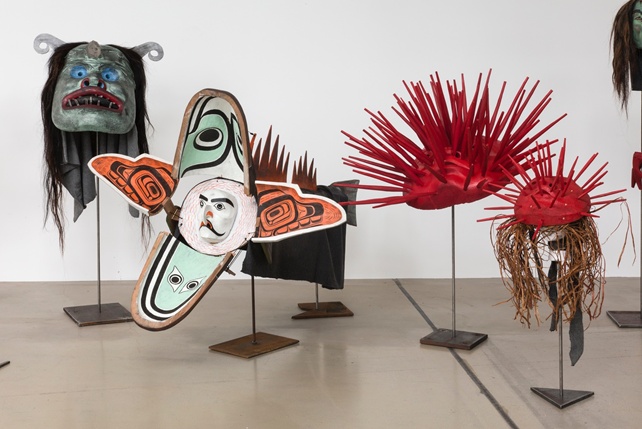
Fig. 1: Beau Dick, installation view of Undersea Kingdom series, 2017, Kassel, documenta-Halle.
Source: Hopkins 2017b, photo courtesy: Roman März.
These are masks made by Beau Dick (1955 – 2017), a wood carver, hereditary chief, and political activist turned contemporary artist. Born in the Kwakwaka’wakw village of Gwa’yi on Vancouver Island in British Columbia, he learned the traditional craftsmanship of wood carving at an early age, and, in focusing on the making of masks, became one of the most internationally regarded Kwakwaka’wakw artists.2 In fact, his participation in documenta 14 helped him gain even wider recognition in the global art scene—a breakthrough he was not able to witness, unfortunately, on account of passing shortly before the quinquennial exhibition’s inauguration. Beau Dick’s contribution to documenta 14 consisted of the presentation of a variety of his masks as well as an enactment of a ritual with these masks at the opening of the exhibition in Kassel.
In this essay, I propose that the Western art historical criteria for the judgment of art of non-Western and indigenous artists are inadequate to evaluate some of their specific artistic practices. All too often, these criteria are based on the binary opposition of art history and ethnology and thus on inclusion in or exclusion from the aesthetic canon. The difficulties of cross-cultural art discourse were readily apparent in reviews assessing the curators’ display of Beau Dick’s masks as exploitation of “Otherness.”3 As I will show, the critical disconnect of documenta 14, which focuses on the inclusion of many formerly unknown artists, is symptomatic of the need to expand the discourse of an art history that is truly global and therefore able to describe many different artistic practices. But why do we have such a clear idea of the division of tasks between art museums and their ethnographical counterpart in the first place? Could we be reaching an intellectual deadlock when describing art from non-Western traditions with Western academic language and the corresponding criteria? And what kind of artistic strategies can be deployed by indigenous artists to overcome this binary attitude?
The dichotomy of art history and ethnology
The notion of art has been discussed thoroughly in the discipline of Western art history—and still, or maybe because of that impulse, the discipline cannot neatly file every work within a singular definition. This is especially emblematic for cultural works produced by non-Western peoples often deemed World Art.4 In contrast, the discipline of anthropology, which always served as a complement to art history, discusses the works typically denied the label of art.5 An anthropological approach toward art can be found, for example, in the writings of Clifford Geertz that call for a semiotics of art privileging experience, since “such signs and symbols, such vehicles of meaning, play a role in the life of a society, or some part of a society, and it is that which in fact gives them their life.”6 But, just like every other concept, the notion of art in Western discourse is complicated by all kinds of power relations. There are prevalent definitions of what is and what is not art in a certain context, but these definitions do not amount to stable ontological categories. Thus, the conception of art can be conceived as alterable and flexible. Acknowledging and critically evaluating works from non-Western artists could lead to a major shift in the judgment of art—in fact, similar processes occurred, for example, concerning Marcel Duchamp’s readymades. The staging of everyday objects in the museum space demanded for a new terminology and new discourses shaping the differences between these objects and artworks. Moreover, the readymade rendered the power of (Western) institutions visible: Placing objects into the art museum could legitimize their status as artworks—at least for those objects produced by the Western artist. At the same time, objects acquired through the exploitation of other cultures could not enter the status of Western artworks; they were placed either in the ethnographical museum or the encyclopedic or universal museum, such as the British Museum. While the encyclopedic museum desires to display artifacts from around the world to “enlighten” viewers about the richness of cultural alterity, this does not automatically put these objects on equal footing: The presentation of objects in a Westernized manner affirms colonial dominance, while restricting access to them due to their being housed in primarily European or North American institutions. Resistance to this blatant expression of cultural imperialism calls for a decolonized approach on behalf of encyclopedic and ethnographic museums alike.7
There is a long history of such objects that were regarded as primitive compared to Western art, which, in turn, was conceived as unique while ethnographic objects became representative of an entire culture.8 In turn, the object was not only denied a position in the dispositif of Western aesthetics but also lost its connection to its initial culture and meaning.9 Although there have been great developments in the question of art or artifact over the last century, discourses labelled Global Art History or World Art can still be problematic when entrenched in Western frameworks.10 For example, in his essay The Glocal and the Singuniversal, Thierry de Duve argues against the spectacularization and economization of biennials around the globe by employing Immanuel Kant’s idea of a sensus communis, or the ability to share feelings.11 In line with his attempt to create a concept of the global based on the writings of one of the key figures of the Enlightenment—a movement that greatly contributed to this distinction between art and ethnographical artifacts—de Duve, yet again, formulates an ideal form of universalism. This ideal is impossible to achieve due to the glass ceiling hindering artists from non-Western parts of the world to establish themselves in the same way as Western artists. Although the use of a critical discourse of aesthetics might seem like a well-intended, humanist concept, a lingering question remains: instigated by whom? Hereinafter, I will show how documenta 14 tried to oppose these premises by inviting artists unknown to the Western art canon and providing them with a possibility to enact narratives founded in non-Western frameworks.
Beau Dick’s strategy of predetermined usage
Beau Dick’s contribution to documenta 14 was one of these instances that brought into relief a different approach to aesthetics. For the Kwakwaka’wakw, a concept of art analogous to the Western notion of art does not exist.12 This is because the distinction between nature and culture does not serve as a binary opposition but is understood as interconnected. T. J. Demos points out that the dichotomy of nature and culture is a Western phenomenon spread by colonialism, while the contemporary attempt to deconstruct this binary opposition under the notion of Post-Anthropocentrism is merely an appropriation of age-old indigenous knowledge.13 Insofar, what might be called a work of art in Western terms—a mask by Beau Dick, for example—does not trigger the same reference in context of the socially integrated ritual. As apparent at documenta 14, the mask only becomes a work of art the moment it is displayed inside the art museum. Outside the museum, the masks serve in the ritualistic dances performed during the Winter ceremonials, where each of them symbolizes a distinct character. Generally, a mask can be used in the dances up to four times before they need to be put to rest for four years and, after that, they must eventually be burned. This is what happened to many masks of the Atlakim series after the final closing of documenta 14 on September 17, 2017.14 However, not all the masks were reduced to ashes. Some of them were produced deliberately to be sold on the art market. We could put this strategy into art historical terms and call it institutional critique: producing masks for traditional use as well as masks for commercial use is providing Beau Dick with both the material circulation of his work that produces economic capital as well as their immaterial circulation which produces cultural capital. According to Pierre Bourdieu, cultural capital refers to intangible social resources like education, skills, personal taste in art as well as artistic practices, and is “[…] convertible, on certain conditions, into economic capital”.15 Thus, cultural capital helps to spread Beau Dick’s reputation as an indigenous activist, while the ritual masks, destined to be burned, refuse the circulation of economic capital and the generation of surplus value through their withdrawal from the art market. They cannot be owned, and they cannot be speculated upon, which contradicts the general function of the artwork as a status symbol and asset.16 However, to call the production of masks for the market a strategy of institutional critique does not acknowledge the masks’ original function. The masks produced for the market, in the end, do not give us a complete picture of the work, because the commercial mask production cannot stand on its own, separate from the cycle of ritual masks. Expressing Beau Dick’s masks in words shaped by Western art discourse proves to be incomplete, as they predominantly refer to a historical canon that cannot explain the multi-layered strategy of agency performed by the artist.
The Undersea Kingdom series and the big, great whale
One of the exhibits that serve as a starting point for my examination is a mask called Killer Whale. It is part of the Undersea Kingdom series begun in 2016. (Fig. 2) It was made from red cedar wood, acrylic paint, cloth, and, most surprisingly, a personalized, plastic action figure, adding up to a total size of 42 x 15 x 60 inches. The unusual form consists of an elongated, rounded middle part with a folding structure at the front and a vertical element which represents a dorsal fin in the middle. The use of black and white paint suggests the depiction of a killer whale: distinct body shapes such as the flappers are outlined in black and flat surfaces are filled out with white. Structurally, the mask seems to be made up of different body parts compressed into the shape of a whale. The nostrils, for example, consist of red ovoids containing black outlined ovoids, containing even smaller opaque ovoids in white. Beau Dick’s painting technique is firmly based on drawing styles commonly practiced in Northwest Coast art.17 In other words, he translates this understanding of outline, filling-in shapes and highlighting from the flat graphic drawing to three-dimensional space—with, of course, some twisting and tweaking once materialized in the plastic form. However, this aesthetic unity is somewhat challenged by the action figure standing squarely on the whale’s back. The figurine is responsible for holding the string that controls the retractable mechanism to open and shut the whale’s jaws. With long grey hair, an eye-catching hat, a red feathery top, and black trousers the figurine looks strikingly similar to the artist himself and is placed as if riding the whale. This toy mini-me was the very last addition Beau Dick made to his masks for documenta—thus materializing a form of art historical notion of the self-portrait upon the figure. Curator Candice Hopkins writes in her obituary on Dick: “True to form, he was the one pulling the strings. One of the preparators who worked closely on the installation of his work remarked that this is likely where Beau is now, riding on the back of the whale.”18 The whale is a frequently appearing motif in Northwest Coast art referring to victims of drowning: A recurring narrative tells the story of a whale that abducted people and brought them to the underwater Village of the Whales, where they would transform into cetaceans.19 Whales that appeared near the coastline were considered by locals to be drowned spirits trying to communicate with their ancestors. Beau Dick possibly regarded the giant mammals as creatures reappearing in another form in the circle of life—if so, the symbolic gesture of self-representation as an action figure seems consoling in hindsight of his passing. Moreover, Beau Dick was also given the name of Walis Gwy Um in Kwak’wala which translates to “big, great whale”.20
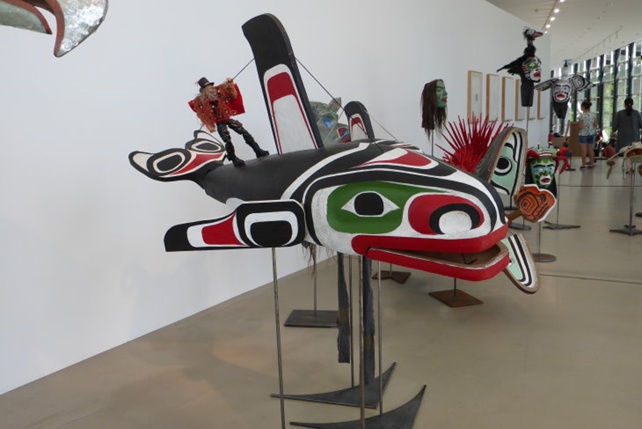
Fig. 2: Beau Dick, Killer Whale mask, 2016-17, red cedar, acrylic paint, string, plastic action figure, 42 x 15 x 60 in., Kassel, documenta-Halle.
Source: Cornelia E. Nauen, documenta 14 – the planetary scope of contemporary art, in: Mundus maris, November 2, 2017, URL: https://www.mundusmaris.org/index.php/it/recensioni/mostre/1809-documenta-14it?showall=&start=2 [24.2.2019].
The overall narrative of the masks of the
Undersea Kingdom series is the odyssey of a boy drawn into the underwater realm of
Komokwa: “The Undersea Kingdom are his [Beau Dick’s] people and their legends. […] All of the figures come from a Kwakwaka’wakw story based on a young boy, Yola Kamay.”
21 Every single mask represents a certain role in the play enacted during the most important ritual, the Winter Dance. Beau Dick originally planned to perform the dance of the
Undersea Kingdom masks at the Parthenon in Athens: “He thought that by doing the ceremony, blessing the space, blessing Athens, and really challenging the political turmoil that is going on there right now, that it could have a ripple effect on the spiritual realm, that it could create a better world.”
22 As he did not have the opportunity to do so himself, LaTiesha Fazakas and Kwakwaka’wakw artists Alan Hunt and Cole Speck greeted the masks in Athens and Kassel and performed a blessing spell on them.
23 On June 10, 2017, Hunt and Speck also enacted
The Story of Yola’kwame at
documenta-Halle using the
Undersea Kingdom masks, providing a rare performance of Kwakwaka’wakw ritual for visitors and fulfilling Beau Dick’s wishes. (Fig. 3) Laura Peers, who worked extensively on cultural repatriation, refers to such processes as “ceremonies of renewal.”
24 In such moments, the significance of the masks is living up to their full potential: Only by being worn for their traditional purpose can the masks really come alive. Since the ritual is set in a contemporary exhibition space, we can attach the notion of contemporary art to it, but again, what is left to gain from this labelling remains debatable.
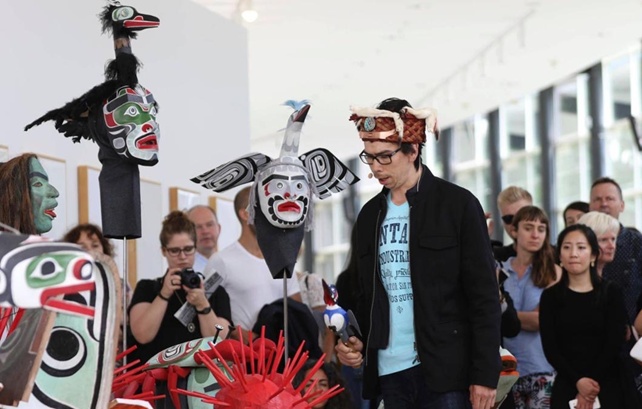
Fig. 3: Alan Hunt, Cole Speck, performance of the Undersea Kingdom series, 2017, Kassel, documenta-Halle.
Source: Bettina Fraschke, documenta 14 setzt auf vielfältige Performances, um ihre Anliegen zu vermitteln, in: Hessische/Niedersächsische Allgemeine, June 13, 2017, photo courtesy: Klaus Schachtenschneider, URL: https://www.hna.de/kultur/documenta/documenta-14-setzt-auf-vielfaeltige-performances-um-ihre-anliegen-zu-vermitteln-8401569.html [24.2.2019].
Notes on the potlatch and contemporary indigenous activism
To acquire a deeper understanding of the present-day issues raised by Beau Dick’s work, it is vital to look back at the cultural trauma of the colonization of modern Canada. Putting aside the abominable invasion and seizing of indigenous land, the most pressing problem was the inability for two different economic and judicial value systems to coexist. The Kwakwaka’wakw defined their social and economic system by celebrating a festival named potlatch, which has been described by Marcel Mauss as “the system of gifts exchanged.“25 Only performed during the most special of occasions such as marriage, the ceremony consists of the host sharing accumulated goods with their guests—without creating an implication of repayment or indebtedness. However, the economic principle of property insists on a clearly demarcated border. It requires the use of personal pronouns: mine, his, hers, theirs. As much as it asserts ownership of a piece of property, it denies access to that property from others. In contrast to the exclusivity of possession, the potlatch is more concerned with the redistribution of wealth—a system based on the benevolence of sharing. The status of the chieftain is ultimately defined by how much they give rather than how much they own. Thus, the implications of power signified by wealth, so widely upheld in feudal and capitalist systems, claim no great importance in the Kwakwaka’wakw society.
The colonizers who formed the nation state of Canada on the lands of indigenous people proclaimed a ban on the potlatch from 1885 to 1951.26 Their in-depth incomprehension of emic culture paired with the mindless belief of moral superiority resulted in Western structures devouring the local traditions—nowadays, we might call this process cultural consumption. The act of expropriation was justified by Christian ethics. Prosecutors believed that the Kwakwaka’wakw had “renounced the gift, and their renunciation brought them over to the ’civilized’ side of the border between civilization and barbarity.”27 Anthropologist James Clifford called this the salvage paradigm, defining it as “reflecting a desire to rescue ‘authenticity’ out of destructive historical change.”28 This is rooted in the Western grand narrative of the distinction between history and tradition, art and ethnographical object, nature and culture, and so on. As the Western hegemonic ideology is one of linearity, progress, and superiority over all other cultures, it comes as no surprise that the colonizers of turn-of-the-century Canada thought that the assimilation of First Nations people—in other words, their adapting and subordinating into the dominant culture—equals integration. In this light, severing ties with cultural traditions is necessary in order to become a part of the prevailing society, since integration in the sense of a fusion of two cultures was never at issue.
However, the tensions between First Nation peoples and the Canadian government were not reconciled with the reintroduction of the festival in the 1950s. The potlatch is still celebrated today, although its function is adjusted to external circumstances: Instead of negotiating and stabilizing the society’s order through redistribution of goods, it reinforces the cultural identity of First Nations people—not just before of the Canadian government, but also in form of cultural heritage adding to a global art world. Moreover, it can also serve as a form of critique: On February 10, 2013, Beau Dick performed the copper-cutting ceremony, a Kwakwaka’wakw ritual that had not been conducted since the 1950s, in front of the parliament in Victoria. Before breaking the copper plate, he stated: “The copper is a symbol of justice, truth, and balance, and to break one is a threat, a challenge and can be an insult. […] If you break copper on someone and shame them, there should be an apology.”29 The breakage was aimed at the Canadian government as a reaction to its treatment of the First Nations people and the maltreatment of their lands. Similar to the actions during the potlatch ban, Beau Dick’s copper-cutting ceremony exemplifies the use of a non-Western tradition as a form of integration of cultures.
Anthropophagy and cultural consumption
Drawing on the phenomenon of cultural consumption as well as the history of the potlatch, we need to turn to Beau Dick’s masks of Dzunukwa, a mythological creature wandering in the woods. (Fig. 4) Made of red cedar wood, black and red pigment, Dzunukwa’s face is surrounded by shaggy dark brown horse hair sprouting exceedingly from the top of the head, forming bushy, long eyebrows and an overgrown mustache. Her skin is raven, but some crimson highlights have been painted on the nose, cheekbones, and open lips. The frozen squinting grimace gives the impression of uttering a loud “HU!” sound, which can be also traced back to the emerging deep crevices around her nose and mouth.30 Although the marks of the carving are easily visible to the naked eye, the fusion of the dark colors, real hair, and sullen expression appears strikingly realistic at first sight.
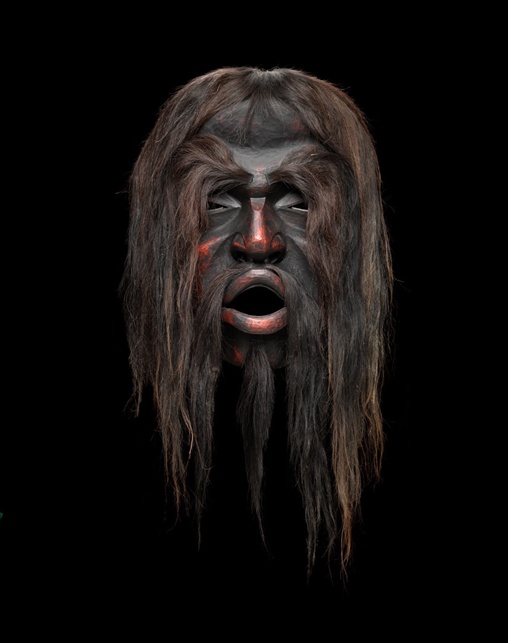
Fig. 4: Beau Dick, Dzunukwa mask, 2016, red cedar wood, acrylic paint, horse hair, Whistler/CA, Audain Art Museum.
Source: Hopkins 2017c.
In mythology, Dzunukwa is described as a giant wild woman who is wandering around the woods wailing, always on the lookout for stray children that she can collect and carry home in her cedar wood basket before ultimately eating them.31 The host of the potlatch also wears a Dzunukwa mask to signify that the feast is over. Her male counterpart, called Bakwas, is similarly described as a wild man living in the woods. He is known for offering his victims poisonous foods before stealing their souls.32 Although Dzunukwa and Bakwas could easily be dismissed as protagonists of children’s horror stories, retold to discourage them from roaming the woods on their own, there seems to be a greater significance reflected in both myths. Both creatures are connected to feeding as well as death—in the form of anthropophagy by Dzunukwa, and in form of offerings of poisoned food by Bakwas. Although Beau Dick carved the masks based on their countenances, there is no acute attitude of neglect or terror expressed toward those masks. Rather, they seem to symbolize something inherently omnipresent: the giving and taking of life. In another myth, people become fed up with Dzunukwa’s roving about and decide to hunt and burn her alive.33 But when her skin starts to burn, her body transforms into a swam of mosquitos, thus escaping certain death. A possible interpretation of this story may convey that death is not the final experience, but a transformation toward something else. This would suggest a more circular worldview that is quite different from the Western notion of an afterlife. Moreover, this might also be applicable to the afterlife of artworks: Beau Dick’s usage of precise instructions on further uses of his masks and the significance of Dzunukwa’s cannibalism could serve as an allegory for cultural consumption in the form of one eating the other.34 Like so many other masks, the Dzunukwa mask might just be burned one day, thus ending the line of consumption for good.35 In addition, the topic of cultural consumption can also be linked to documenta 14. Referring to topics like crises, wars, identity politics, globalization, and grand narratives, the curatorial team did not just seize on issues of post-crisis Athens, but on the power relations between Kassel and Athens, Germany and Greece, the global North and South—most manifest in the symbol of the border.36 documenta 14 has received criticisms from mainstream media and the art press alike for addressing these rather uncomfortable topics. Shortly after the end of the exhibition, a German newspaper accused the management of generating a debt of € 7 million.37 As the exhibition largely depends on public funding, it did not take long for exaggerated claims to emerge: documenta should be stopped from wasting tax payer’s money and close down.38 It is revealing that the critique faced by the curatorial team resembled the one-dimensional rhetoric directed toward any corrupted bank or government. Instead of celebrating the surplus of cultural capital that documenta 14 generated, only the fiscal benefits, or lack thereof, were discussed. During the largely German-negotiated austerity plan for Greece following the economic crisis of 2007, financial debt served as a position of subjugation, thus establishing a power relationship that favored the actor possessing greater capital. Beau Dick’s practice subverts these kinds of power relations by strategically determining the usage of his masks, and by publicly calling out offenders, as demonstrated in his copper-cutting ceremony.39 These issues of consumption, like the devouring of local cultures through colonization or the usage of debt as a commitment to subordination, are reflected in distinct motifs of his masks like the one of man-eating Dzunukwa.
Implications of Beau Dick’s strategies of agency
Beau Dick’s artistic practice is characterized by his attempts to operate on different or even contradictory fields, like the making of masks and contemporary art. But what kind of preconceived notions complicate the discussion of his work in the field of art history? According to American anthropologist Sally Price, the biggest prejudices toward non-Western artists include the assumption that all indigenous art was made anonymously.40 This is in stark contrast to the genius narratives often attached to Western artists that are focused on individualization. Likewise, many European artists, especially those who lived before the Renaissance, cannot be clearly identified as well—however, there are many attempts to trace back their identities using historical methods. Accessing a church register or archive to track down creators of indigenous art is simply not possible. Additionally, the often-imprecise descriptions of place and time of origin forestall objectification by Western institutions: Maybe the works were not necessarily meant to be localized in a linear historical narrative. In the same way, perhaps a particular author was also not essential to a highly valuable work. It is plain to see that the categorization of indigenous art into the narrative of art history is tantamount to squeezing it into existing categories that do not accommodate its characteristics. Therefore, a globally oriented art history should be able to consider as many different characteristics as possible. Price also points out that up until now, the predominant perception is that indigenous people do not have a conception of art, and therefore must lack a sense of aesthetics in general. Her argument is confirmed in the light of the press coverage on documenta 14. For example, a review of Swiss newspaper Neue Zürcher Zeitung, which described Beau Dick’s installation as “funny background for Instagram photos”, continued: “At Hagenbeck [a zoo] near Hamburg, at the beginning of the twentieth century, they imported entire families from the Congo and put them in the zoo to make the elephants look more authentic.”41 Besides the fact that ethnographer Franz Boas did actually invite Kwakwaka’wakw people as living exhibits to the World’s Columbian Exposition in Chicago in 1893,42 linking the exhibition of ritualistic masks inside a museum to an exhibition of people inside a zoo is a clear process of Othering, and symptomatic of the greatest form of criticism of documenta 14: the problem of binary oppositions. In Homi K. Bhabha’s theories on colonialism, the Other—in this case, the non-European, non-white man—can only perform the role of either the active resistance fighter or the passive victim.43 To view the Other as something else requires not to just step away from this dichotomy but to deconstruct this thought pattern as a trap. As Beau Dick’s masks are neither attacking nor evoking pity in the viewer, Western viewers might realize that their learned mechanisms of perceiving are not sufficient when evaluating non-Western contemporary art. As a result, this lack of understanding provokes precipitance and denunciation. To overcome this vicious cycle, Price suggests acknowledging that there is no such thing as a “naked“ eye but only a gaze enculturated in Western ideology—a gaze that now is being challenged and renegotiated.44 Price concludes that ethnological contextualization contains the opportunity to expand the aesthetic experience of one’s own cultural education. According to the subtitle of documenta 14, Learning from Athens, Beau Dick’s exhibition retains the possibility to re-evaluate one’s own gaze and thus rethink how definitions of art include or exclude.
Throughout his artistic career and especially with his participation in documenta, Beau Dick was trying to find a way to incorporate his duty as Kwakwaka’wakw chief into the power structures of contemporary art exhibitions through political activism. Peers evaluates the participation of indigenous people in museological practices: “Control over representations of the past involves issues of political power, and reflects the balance of power between the dominant society as represented by the heritage elite and minority groups within nation-states.”45 Deployed in documenta 14, Beau Dick provides a model of artistic and curatorial agency from an artist with a non-Western background and demonstrates that it is possible to satisfy many different points of view without extensively commodifying oneself or one’s culture. By addressing issues of consumption and cultural capital from a non-capitalist, Kwakwaka’wakw point of view, Beau Dick not only maintains his agency but also enriches the discourse of documenta 14 in particular and contemporary art in general by a facet of indigenous knowledge. In turn, this provides a new impetus to the evaluation of art: This is evident in his strategic use of the masks produced for the market and those produced for ritualistic usage that evade consumption and retain their significance in the otherwise decontextualizing forces of the exhibition space. This unconventional approach allowed for widespread circulation of his work, leading to solo shows such as Beau Dick: Revolutionary Spirit at the Audain Art Museum and a documentary on his life, Maker of Monster: The Extraordinary Life of Beau Dick. And, what might he have possibly said in response to the financial fiasco of documenta 14? Maybe, just maybe, he would have suggested hosting a potlatch.
1 I would like to thank Prof. Noit Banai for supporting my writing on Beau Dick, LaTiesha Fazakas for giving me many insights into Kwakwaka’wakw ideas, and Julia Jarrett for her aid and support during the writing process.
2 Candice Hopkins, In Memoriam. Beau Dick (1955 – 2017), in: documenta 14, Notes, 2017a, URL: http://www.documenta14.de/en/notes-and-works/17052/in-memoriam-beau-dick-1955-2017- [24.2.2019].
3 Susanne von Falkenhausen, Get Real, in: Frieze, June 7, 2017, URL: https://frieze.com/article/get-real-0 [24.2.2019].
4 In the fields of art history and ethnology, World Art indicates “the art of the others because or although it was mostly to be found in Western museums.” See Hans Belting, From World Art to Global Art. View on a New Panorama, in: Hans Belting, Andrea Buddensieg, Peter Weibel (eds.), The Global Contemporary and the Rise of New Art Worlds, The Global Contemporary. Art Worlds after 1989 (cat.), ZKM Center for Art and Media Karlsruhe, Cambridge, MA 2013, p. 178 – 185.
5 Ruth Phillips, Museum pieces. Toward the indigenization of Canadian Museums, Montreal 2011, p. 102.
6 Clifford Geertz, Art as a Cultural System, p. 1498, in: Modern Language Notes, Vol. 91, No. 6, December 1976, p. 1473 – 1499.
7 Rafia Zakaria, Looted Art and the ‘Universal Museum’: Can 21st-Century Collections Ever Escape Colonialism’s Violent Legacy?, in: Frieze, November 28, 2018, URL: https://frieze.com/article/looted-art-and-universal-museum-can-21st-century-collections-ever-escape-colonialisms [24.2.2019].
8 Kate Sturge, Representing Others. Translation, Ethnography, and the Museum, New York 2014, p. 150.
9 Hans Belting, Contemporary art and the museum in the global age, in: Disputatio, Vol. 1, No. 2, 2012, p. 16 – 30.
10 For a detailed analysis of the difficulty of such discourses, see Susanne Leeb, Die Kunst der Anderen. “Weltkunst” und die anthropologische Konfiguration der Moderne, Berlin 2015; as well as Hans Belting, Andrea Buddensieg (eds.), The Global Art World. Audiences, Markets, and Museums, Ostfildern 2009.
11 Thierry de Duve, The Glocal and the Singuniversal, in: Third Text, Vol. 21, No. 6, 2007, p. 681 – 688.
12 Email Interview with LaTiesha Fazakas, conducted by the author, November 16, 2017. Fazakas is the owner of Fazakas Gallery, Vancouver, and acted as curatorial coordinator of Beau Dick’s participation in documenta 14.
13 T.J. Demos, Decolonizing Nature. Contemporary Art and the Politics of Ecology, Berlin 2016, p. 22 – 23. To go even further, the fundamentality of dichotomous thinking, for example man-woman, primitive-civilized, and inside-outside, is discussed in Jacques Derrida, Of Grammatology, Baltimore 1988, p. 33 – 34.
14 Saskia Trebing, Was mit den Kunstwerken passiert, wenn die documenta 14 vorbei ist, in: Hessische/Niedersächsische Allgemeine, September 13, 2017, URL: https://www.hna.de/kultur/documenta/passiert-mit-kunstwerken-wenn-documenta-14-vorbei-ist-8679905.html [24.2.2019].
15 Pierre Bourdieu, The Forms of Capital, in: John G. Richardson (ed.), Handbook of Theory and Research for the Sociology of Education, New York 1986, p. 243.
16 Isabelle Graw, Der grosse Preis. Kunst zwischen Markt und Celebrity Kultur, Cologne 2008, p. 26. Please note that Graw uses the term “symbolic capital” as an umbrella term for cultural and social capital which is common in the reception of Bourdieu.
17 Hilary Stewart, Looking at Indian Art of the Northwest Coast, Vancouver 1979, p. 19.
18 Hopkins 2017a.
19 Stewart 1979, p. 42.
20 Candice Hopkins, Beau Dick, in: documenta 14, Artists, 2017b, URL: http://www.documenta14.de/en/artists/13689/beau-dick [24.2.2019].
21 Imogen Jefferies, Beau Dick’s „Undersea Kingdom“ at Fazakas Gallery, in: Montecristo Magazine, November 1, 2017, URL: http://montecristomagazine.com/arts/beau-dicks-undersea-kingdom-at-fazakas-gallery [24.2.2019].
22 Jefferies 2017.
23 Email interview with LaTiesha Fazakas, November 16, 2017.
24 Laura Peers, ‚Ceremonies of Renewal‘. Visits, Relationships, and Healing in the Museum Space, 2013, in: Museum Worlds: Advances in Research, Vol. 1, p. 138.
25 Marcel Mauss, The Gift. The Form and Reason of Exchange in Archaic Societies, London 2002, p. 45.
26 Ironically, indigenous people managed to maintain their cultural identity by disguising potlatches during the ban as gifts of Christian charity. See Candice Hopkins, Outlawed Social Life, in: South as a State of Mind, No. 7, 2017c, URL: https://www.documenta14.de/en/south/685_gesellschaft_als_verbrechen [24.2.2019].
27 Christopher Bracken, The Potlatch Papers: A Colonial Case History, Chicago 1997, p. 42 – 43, cited in Hopkins 2017c.
28 James Clifford, Of Other Peoples. Beyond the „Salvage Paradigm“, in: Hal Foster (ed.), Discussions in Contemporary Culture, No. 1, Seattle 1987, p. 121 – 130.
29 Judith Lavoie, First Nations chief to perform rare shaming rite on legislature lawn, in: Times Colonist, February 9, 2013, URL: http://www.timescolonist.com/news/local/first-nations-chief-to-perform-rare-shaming-rite-on-legislature-lawn-1.70849 [24.2.2019].
30 Hopkins 2017b.
31 Franz Boas, The Social Organization and the Secret Societies of the Kwakiutl Indians, in: Report of the United States National Museum for the year ending June 30, 1895, p. 372.
32 Hopkins 2017b.
33 Hopkins 2017c.
34 Hopkins 2017b.
35 Masks produced for the market can also be utilized in rituals—but still need to be burned after a preset number of usages. See Hopkins 2017b.
36 Noit Banai, Border as Form, in: Artforum International, Vol. 56, No. 1, 2017, p. 302 – 305.
37 Florian Hagemann, Horst Seidenfaden, Frank Thonicke, Leiter setzte Geld in den Sand. documenta-Pleite war schon in Sicht, in: Hessische/Niedersächsische Allgemeine, September 12, 2017, URL: https://www.hna.de/kultur/documenta/documenta-14-in-kassel-war-pleite-buergschaften-retten-ausstellung-8675464.html [24.2.2019].
38 Andrew Russeth, Documenta 14 Reports Record Attendance, in: Artnews, September 19, 2017, URL: http://www.artnews.com/2017/09/19/documenta-14-reports-record-attendance/ [24.2.2019].
39 Prof. Noit Banai included these thoughts in her lecture The Global Museum at University of Vienna during winter term 2017/18.
40 Sally Price, Primitive Kunst in zivilisierter Gesellschaft, Frankfurt/Main 1992, p. 136.
41 Translation by the author. Annegret Erhard, „Krachend gescheitert“, in: Neue Zürcher Zeitung, July 2, 2017, URL: https://www.nzz.ch/feuilleton/documenta-14-in-kassel-krachend-gescheitert-ld.1303706 [24.2.2019].
42 Hopkins 2017c.
43 Homi K. Bhabha, The Location of Culture, London 1994, p. 13.
44 Price 1992, p. 141.
45 Laura Peers, Revising the past. The heritage elite and Native peoples in North America, in: Cris Shore, Stephen Nugent (eds.), Elite Cultures. Anthropological perspectives, London 2002, p. 184.